By
Claire Bernish
Asbestos. Though you’re likely familiar with the insidious minerals
used in fireproofing and a number of other applications, first
responders to the September 11 attacks on the World Trade Center and
residents in the area know intimately the dangers it can pose.
Once you’ve breathed in even a single fiber of asbestos — a “known
human carcinogen” — you’re theoretically at risk for developing cancer,
asbestosis, mesothelioma, and more. Though the National Cancer Institute
states
“[e]veryone is exposed to asbestos at some time during their life,”
repeated or sustained exposure poses the greatest risk. And it
specifically lists first responders to 9/11, volunteers who helped
during the aftermath, and residents “in close proximity” to the site as
having documented health effects from asbestos and other unknown toxins
released into the air that day.
In recent days, there has been much discussion concerning
responsibility for Saudi Arabia’s alleged role in the attacks — and the
possibility the kingdom’s involvement may be divulged should Pres. Obama
release the ‘missing’ 28 pages from the 9/11 files. But what hasn’t
been discussed is the lack of or limited accountability by the United
States government in caring for peripheral victims who continue to
suffer — and die from — exposure to asbestos and other toxins.
As Luke Rudowski, founder of
We Are Change — who was living in the path of the toxic particulate miasma that day — explained in a
new video, the government’s shirking of responsibility could easily be called “criminal.”
“In the beginning, everyone always said, ‘well, the government
wouldn’t lie to us, they said that the air was safe to breathe,’ and
especially living in New York City, the emotional trauma that 9/11
brought upon everyone was intensified because we were there,” Rudowski
explained in an interview with
The Free Thought Project about his personal experience.
I knew many people who lost loved ones and who were
missing people. It was an utterly chaotic day — just utter fear
controlling everyone; and because of that, everyone trusted everything
the government said.
After the attacks, you were just inundated with state-run television
that was just broadcasting all this tremendous fear, and when they said
the air was safe to breathe, there was … really no reason for me not to
believe that.
This isn’t just some far-flung theory. As
Scientific American wrote
on the tenth anniversary of the attacks, as also noted by Rudowski in
his video, the then administrator of the U.S. Environmental Protection
Agency Christie Whitman told the public on September 13, 2001, “EPA is
greatly relieved to have learned that there appears to be no significant
levels of asbestos dust in the air in New York City.” Adding, “We will
continue to monitor closely.”
Five days later, she perpetuated the lie by reiterating firmly,
“I am glad to assure the people of New York and Washington, D.C., that the air is safe to breath [sic].”
But it wasn’t.
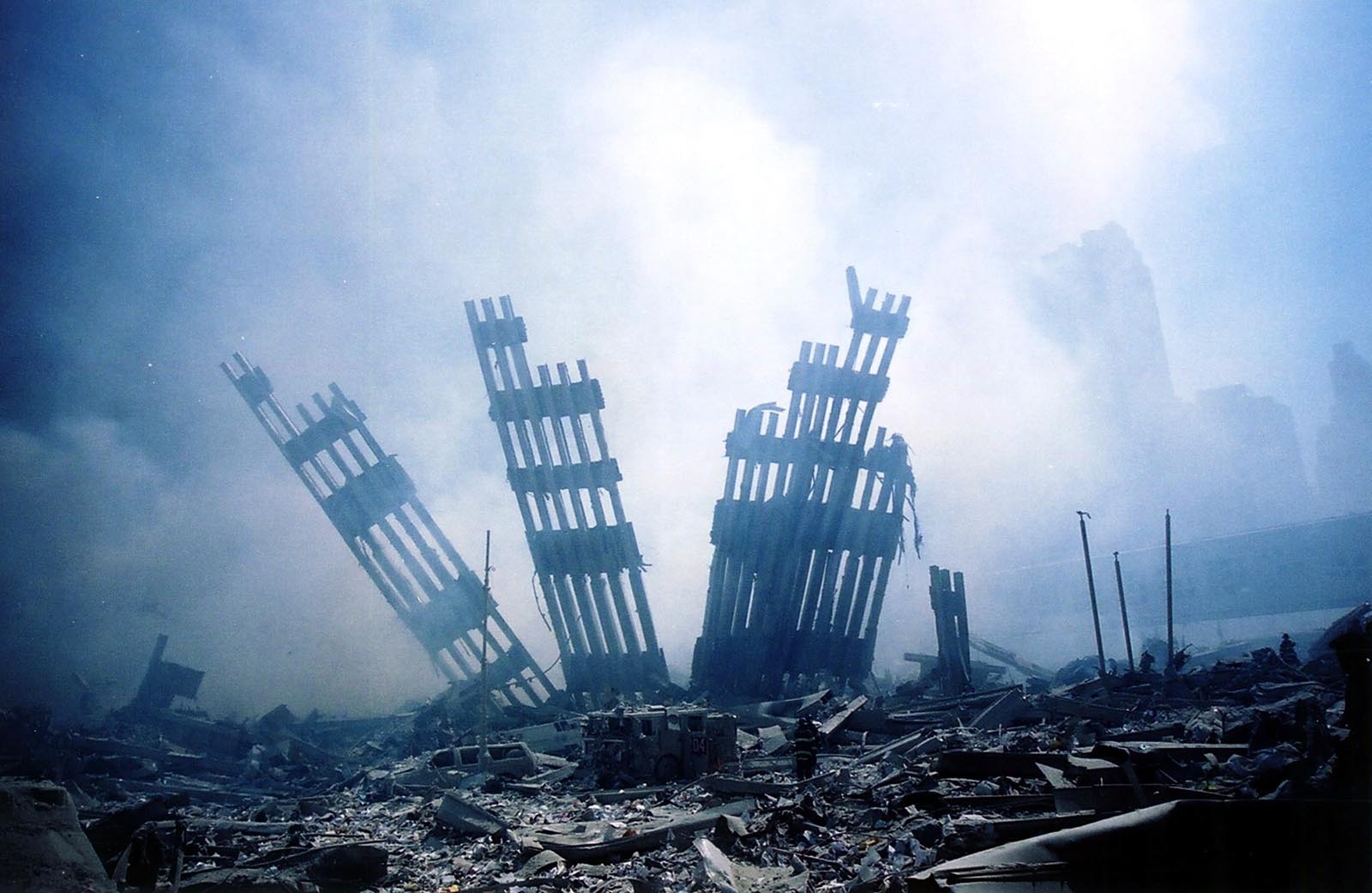
Asbestos that had been used in the construction of the North Tower of
the World Trade Center ballooned out in a putrid, toxic cloud
containing untold quantities of other toxins and particulates — and has
since caused illness, respiratory ailments, and fatalities in an unknown
number of people present that day.
In fact, the Inspector General of Whitman’s own agency concluded two
years after she’d assured people’s safety, that the EPA “did not have
sufficient data and analyses to make such a blanket statement.” Of the
myriad samples the EPA did collect in the weeks following the attack, 25
percent contained levels above the 1 percent “safe” threshold
indicative of “significant risk.”
“Competing considerations, such as national security concerns and the
desire to reopen Wall Street, also played a role in the EPA’s air
quality statements,” the Inspector General noted in the report in 2003.
That deception in the interest of, essentially, the banking interests
and the government quite possibly directly influenced the decisions of
volunteers — firefighters, police, health workers, local residents,
concerned civilians, and members of the military — to work at or near
Ground Zero in the days and weeks following. Worse, as Rudowski
explained, volunteers were told protective masks and gear were
unnecessary — and should be removed.
“It was not just the family members [of the victims] who were getting
screwed over by the government, but those who were down there helping …
in the [cleanup] efforts. They were dropping dead and becoming ill; and
it was swept underneath the rug, and … finally, people started talking
about, ‘Hey, I was at Ground Zero and now I have lung cancer.’ Or ‘I
have mesothelioma’ or ‘I have this strange disease that no doctor can
classify.’ And those were the first people who were affected by it,”
said Rudowski.
That’s when I saw that, yeah, the air was extremely hazardous.
Indeed, it was.
According to Scientific American, the two towers had contained “heavy metals, such as
lead,”
“polychlorinated biphenyls (PCBs) … that are toxic on their own and
become even more toxic when burned at high heat, and glass fibers that
lodge in the lungs. The levels of dioxin measured in the air near the
smoldering pile ‘were the highest ambient measurements of dioxin ever
recorded anywhere in the world,’ levels at least 100 times higher than
those found downwind of a garbage incinerator,” reported a 2007
analysis by the EPA.
“After
9/11 and during 9/11, I was in Brooklyn, directly in the path of where
the wind was carrying the toxic smoke,” Rudowski continued, “so the dust
was all over the street, was all over the car, all over the house, was
all over … you know, everywhere. And you could write your name, like it
was in the snow, on cars — but it was all the dust from 9/11.” He noted,
somewhat eerily, there were “papers from the World Trade Center” that
had blown into the streets — all the way across the East River, into his
Brooklyn neighborhood.
Rudowski explained that though he was a teenager at the time, the
attacks and subsequent cleanup effort — and mounting lies from the
government surrounding the attacks — became a pivotal moment in his
life. He began going to Ground Zero to hand out fliers and speak to
volunteers.
People who survived the attacks and rescue workers
started coming up to us and talking to us — giving us all this
information about how they were told not to wear gas masks; how they
were told not to put on their hazmat suits; and how their health had
been utterly destroyed.
Notably, being told not to take safety precautions likely compromised
the health of an untold number of people. Paul Lioy, environmental
scientist with the
Environmental and Occupational Health Services Institute
in New Jersey — who provided samples of the pulverized dust to various
government agencies after the attack — explained such safety equipment
would have been crucial in preventing future ailments in first and
secondary responders.
“The key is when you arrived, whether you were wearing a respirator
or not, how long you were there and how high the concentrations were
that could lead to effects,” he noted for the
article in
Scientific American.
“I think people who wore respirators have a lower probability of health
effects … People who came early to the site and were not wearing
respirators have a greater probability of having more severe effects.”
“At that time, there was a lot of confusion, and the health effects,
the illnesses, weren’t even classified — couldn’t even be classified —
by many doctors,” Rudowski said. “And now they’ve opened up a special
institute just for that.”
Nearly ten years after the tragedy, the National Institute for
Occupational Safety and Health announced coverage for those who
developed cancer from the various toxins under the
World Trade Center Health Program, established when the Zadroga 9/11 Health and Safety Act was signed into law on January 2, 2011. Named for
James Zadroga,
an NYPD detective who spent hundreds of hours at Ground Zero before
developing respiratory ailments that eventually led to his death, the
Act still presents some hurdles for those affected by the toxic plume
since the full spectrum of toxins released that day has never been fully
evaluated.
Zadroga’s illness and resultant death became the subject of
contention when, though his autopsy revealed otherwise inexplicable
abnormalities, some doctors and scientists flatly refused to attribute
them to his countless hours volunteering at the smoldering site. In
part, they claimed, no comparison had been officially done between air
and dust samples and those found in Zadroga’s lungs — but that somewhat
ignores the lack of a comprehensive analysis of the massive toxic cloud
and settling dust.
New York City Mayor Michael Bloomberg eagerly joined that criticism, originally
saying
of Zadroga in 2007, when the chief medical examiner disputed the
connection between the man’s death and 9/11, “We wanted to have a hero,
and there are plenty of heroes. It’s just in this case, science says
this was not a hero.”
As Rudowski clarified, the controversy over the death involved the
lack of treatment for excruciating pain Zadroga contended with due to
his illness — eventually leading the man to crush and inject pain
medicine in order to cope with everyday living. Those doctors and
medical examiners who disputed his cause of death pointed to the pain
medicine — not the original cause of his pain — in denying Zadroga had
been ultimately killed by the events of 9/11.
After coming under intense criticism of his own for saying so,
Bloomberg somewhat backtracked, stating, in part, “It’s a question of
how you want to define what a hero is, and I certainly did not mean to
hurt the family or impugn his reputation.”
As cruel as Bloomberg’s description of a Ground Zero volunteer might
be, it reflects general governmental attitude toward rescue workers and
others who may not be considered ‘direct’ victims of 9/11. They face the
complex challenge of dealing with illness, establishing an ‘official’
connection between their health issues and 9/11 toxins to gain coverage
under the WTCHP, and fending off both government denial and a general,
prevailing attitude that their sickness must be either all psychological
or that it simply could not be connected to the events of September 11,
2001.
“At first, the government said, ‘No, you can’t be sick from Ground
Zero, you just have Post-Traumatic Stress Disorder.’ And all the first
responders were saying, ‘No. No, this was a toxic plume. This dust was
extremely dangerous and is killing a lot of us,’” Rudowski explained.
“And the government straight out denied it,” he said, specifically
noting Bloomberg’s effrontery statements about Zadroga. “Because there
were so many people sick — about 50,000 first responders — and many of
them were so sick, the medical costs were so huge, that the city said,
‘We’re not going to pay for this,’ and denied first responders even
medical care under their city contracts that they’re entitled to —
because they said, ‘No, this isn’t related to 9/11, it can’t be related
to 9/11. You guys just have [PTSD]. You’re not really sick.’”
But
according to
the National Cancer Institute, one study “found that nearly 70 percent
of WTC rescue and recovery workers suffered new or worsened respiratory
symptoms while performing work at the WTC site.”
Rudowski and the Institute both emphasize it can take decades for the
symptoms of an asbestos-related illness or cancer to manifest — and
that
still doesn’t encompass the myriad illnesses and deaths directly related to unknown particulates and toxins released in WTC dust.
On September 6, 2011, Mount Sinai published results of the first
long-term study
of 27,000 rescue and recovery workers, which found “high incidence of
several conditions, including asthma, post-traumatic stress disorder
(PTSD), depression, sinusitis, and gastroesophageal reflux disease
(GERD). More than one in five of all the responders studied had multiple
physical and/or mental health problems.”
However, “It has never been fully documented correctly because it’s
virtually impossible to keep track of so many people” involved in
rescue, recovery, and cleanup of 9/11, Rudowski explained. “Regarding
first responders, themselves, at Mount Sinai they did some studies … but
a lot of the data is really hard to compile since we’re talking about
hundreds of thousands of people.” Particularly, he notes, because New
York City’s large population is constantly shifting as people move in
and out all the time.
“I had friends who died from this. I had friends who suffered
terribly from all these illnesses and all these horrible diseases they
got because of … the dust from being down [at the site], working. And
those effects will … reverberate within the next ten, twenty, thirty
years — and it’s really hard to pinpoint exactly who gets what [illness]
from what, when we’re talking about those time frames,” he said.
“But if you look at the effects of asbestos, and not only asbestos,
but everything that was in those twin towers — those cathode ray tubes,
the computers — everything was smashed to dust. Everything was
obliterated.”
Last year, on the fourteenth anniversary of the attacks, consultant
for the Centers of Disease Control and Prevention, Max Lum, wrote a
sweeping
statement regarding the health repercussions experienced by those in New York City, stating:
“It is estimated that over 400,000 people were exposed to toxic
contaminants, risks of traumatic injury, and physically and emotionally
stressful conditions in the days, weeks, and months following the
attacks. Symptoms of 9/11 conditions include chronic cough, shortness of
breath, sinus congestion, certain cancers, stress related disorders,
and depression among the many other symptoms and conditions,” adding
there are over 72,000 people currently enrolled in the WTCHP.
Rudowski
first saw the report just days ago, which led him to the map showing
the path of the toxic dust plume — and the making of the video detailing
his personal experiences related to 9/11. Though he understood the
dangers faced by those working the ‘pile’ at Ground Zero, Rudowski
hadn’t considered the potential he could face the same prior to
stumbling upon Lum’s report — and though he is concerned, he repeatedly
emphasized the difficulties faced by first responders and their
families.
And whatever controversies, theories, and opinions may pervade
discussions about September 11, “the real story here … is the plight of
the 9/11 first responders and what they had to go through.”
As the government creates obstacles to health care for those first
responders, rescue workers, volunteers, and area residents and office
workers facing 9/11-related illnesses and conditions, it’s up to us as a
populace not to let their struggles be swept under the rug — or
obfuscated for the sake of larger 9/11 controversies.
In the end, a comprehensive assessment of the number of lives
affected that day — and by events, policies, and illnesses resulting
from the attacks — remains impossible. But it’s imperative we don’t
allow the symbolism of the towers to cloud our understanding of the very
real individuals who paid the price for their being knocked down.
The Free Thought Project would like to thank Luke Rudowski for the interview and for sharing his experience.

 Sin ambages pregunto si será el
último primero de mayo del intento de construir una sociedad socialista, para
vivir el próximo como un combate más de la protesta inútil contra el retroceso
de la historia que nos amenaza. Con esta
correlación de fuerzas, el eje de funcionamiento de la clase obrera, la LOTTT,
se volvió una ventana de vidrio en medio de trifulca a piedras; y sin la LOTTT,
queda abierto el resbaladero hacia la explotación y la discriminación que
pareció superarse definitivamente.
Sin ambages pregunto si será el
último primero de mayo del intento de construir una sociedad socialista, para
vivir el próximo como un combate más de la protesta inútil contra el retroceso
de la historia que nos amenaza. Con esta
correlación de fuerzas, el eje de funcionamiento de la clase obrera, la LOTTT,
se volvió una ventana de vidrio en medio de trifulca a piedras; y sin la LOTTT,
queda abierto el resbaladero hacia la explotación y la discriminación que
pareció superarse definitivamente.  ¿Entendió la clase obrera venezolana
su papel en la revolución que preconizaba Chávez? ¿Superó el reivindicacionismo y le entró de
frente a la participación? ¿Están los
trabajadores de las empresas de referencia de la clase obrera en la vanguardia
del intento de creación del modelo de socialismo que encaminó Chávez? ¿O sólo
gozan de mejores salarios y beneficios en empresas productivamente venidas a
menos y a cargo de la renta petrolera para sobrevivir? ¿Surgió de los trabajadores una burocracia
sindical pérfida como la paradoja de su existencia? ¿Y los trabajadores del terciario, crearon la
capacidad necesaria para prescindir de la capa gerencial soberbia que se adueñó
de las empresas? ¿Y los de las empresas
privadas?... La respuesta a esas
preguntas nos llevarían a aclarar si los avances legales que promovió Chávez
fue más el pago de la deuda histórica infamante, sin la lucha necesaria por
parte de los trabajadores para merecerlos y para mantenerlos como derechos
adquiridos.
¿Entendió la clase obrera venezolana
su papel en la revolución que preconizaba Chávez? ¿Superó el reivindicacionismo y le entró de
frente a la participación? ¿Están los
trabajadores de las empresas de referencia de la clase obrera en la vanguardia
del intento de creación del modelo de socialismo que encaminó Chávez? ¿O sólo
gozan de mejores salarios y beneficios en empresas productivamente venidas a
menos y a cargo de la renta petrolera para sobrevivir? ¿Surgió de los trabajadores una burocracia
sindical pérfida como la paradoja de su existencia? ¿Y los trabajadores del terciario, crearon la
capacidad necesaria para prescindir de la capa gerencial soberbia que se adueñó
de las empresas? ¿Y los de las empresas
privadas?... La respuesta a esas
preguntas nos llevarían a aclarar si los avances legales que promovió Chávez
fue más el pago de la deuda histórica infamante, sin la lucha necesaria por
parte de los trabajadores para merecerlos y para mantenerlos como derechos
adquiridos. ¿El adoctrinamiento revolucionario
nos convirtió en seres con la claridad de saber que cuando el hambre amenaza la
solución es la guerra a muerte contra quien la provoca y no delegar esa actitud
necesaria en nadie? ¿Cómo llegamos a
permitir que un proceso que resistió los intentos más feroces de vencerlo,
fuese puesto en jaque por el hambre programada y formas crueles de distribución? Lejos estamos de las características del
“período especial” que resistió con integridad la revolución cubana; que si
estuviésemos cerca de las carencias que a los cubanos les tocó sufrir,
estuviésemos bajo la tiranía del fascismo apoyada en la ocupación militar
extranjera.
¿El adoctrinamiento revolucionario
nos convirtió en seres con la claridad de saber que cuando el hambre amenaza la
solución es la guerra a muerte contra quien la provoca y no delegar esa actitud
necesaria en nadie? ¿Cómo llegamos a
permitir que un proceso que resistió los intentos más feroces de vencerlo,
fuese puesto en jaque por el hambre programada y formas crueles de distribución? Lejos estamos de las características del
“período especial” que resistió con integridad la revolución cubana; que si
estuviésemos cerca de las carencias que a los cubanos les tocó sufrir,
estuviésemos bajo la tiranía del fascismo apoyada en la ocupación militar
extranjera.  En fin, deteniendo las divagaciones
de nunca acabar y volviendo a la marcha de hoy, afirmo que no expresó las
consignas básicas de la clase obrera en este momento histórico (un cartelito
perdido clamó por la defensa de la LOTTT), lo que puede significar que se
ignoran, que se trataba más de un compromiso laboral, pasivo o espontáneo, pero
compromiso al fin. No en demasía, como
obliga el tiempo que nos toca vivir, pero estuvo nutrida y estaban muchos de
los que son. Nos encontramos viejos camaradas,
bastantes amantes de Chávez que llevan el desespero en el corazón, demasiados
funcionarios y tal cual burócrata de oficio.
Buena parte de quienes asistimos, ocupamos trincheras endebles en la
lucha contra la arremetida del fascismo, porque la línea de trincheras de
referencia, las construidas por el pueblo chavistas, están ocupadas por
funcionarios que en algún momento se encandilaron con el poder y asumieron la
ceguera resultante como forma de conducir el proceso.
En fin, deteniendo las divagaciones
de nunca acabar y volviendo a la marcha de hoy, afirmo que no expresó las
consignas básicas de la clase obrera en este momento histórico (un cartelito
perdido clamó por la defensa de la LOTTT), lo que puede significar que se
ignoran, que se trataba más de un compromiso laboral, pasivo o espontáneo, pero
compromiso al fin. No en demasía, como
obliga el tiempo que nos toca vivir, pero estuvo nutrida y estaban muchos de
los que son. Nos encontramos viejos camaradas,
bastantes amantes de Chávez que llevan el desespero en el corazón, demasiados
funcionarios y tal cual burócrata de oficio.
Buena parte de quienes asistimos, ocupamos trincheras endebles en la
lucha contra la arremetida del fascismo, porque la línea de trincheras de
referencia, las construidas por el pueblo chavistas, están ocupadas por
funcionarios que en algún momento se encandilaron con el poder y asumieron la
ceguera resultante como forma de conducir el proceso. Concluyo afirmando que nos queda poco
tiempo, a no ser que haya un Plan Y –que
bienvenido sería, y que reclamemos con entereza el derecho de expresar
nuestra disconformidad, pero sin cejar y tratando de ocupar o construir
espacios inaccesibles para el fascismo que nos declaró la guerra, la guerra en
la más amplia acepción de este desgraciado fonema.
Concluyo afirmando que nos queda poco
tiempo, a no ser que haya un Plan Y –que
bienvenido sería, y que reclamemos con entereza el derecho de expresar
nuestra disconformidad, pero sin cejar y tratando de ocupar o construir
espacios inaccesibles para el fascismo que nos declaró la guerra, la guerra en
la más amplia acepción de este desgraciado fonema.