Global Research
Click to read this article in your browser.

Or
perhaps one should say, buried or revived? Because for the mass of
ordinary people, far from the political, financial, media centers of
power in Paris, democracy is already moribund, and their movement is an
effort to save it. Ever since Margaret Thatcher decreed that “there is
no alternative”, Western economic policy is made by technocrats for the
benefit of financial markets, claiming that such benefits will trickle
down to the populace. The trickle has largely dried up, and people are
tired of having their needs and wishes totally ignored by an elite who
“know best”.
President
Emmanuel Macron’s New Year’s Eve address to the nation made it
perfectly clear that after one unconvincing stab at throwing a few
crumbs to the Gilets Jaunes (Yellow Vests) protest movement, he has
determined to get tough.
France
is entering a period of turmoil. The situation is very complex, but
here are a few points to help grasp what this is all about.
The Methods
The
Yellow Vests gather in conspicuous places where they can be seen: the
Champs-Elysées in Paris, main squares in other cities towns, and the
numerous traffic circles on the edge of small towns. Unlike traditional
demonstrations, the Paris marches were very loose and spontaneous,
people just walking around and talking to each other, with no leaders
and no speeches.
The
absence of leaders is inherent in the movement. All politicians, even
friendly ones, are mistrusted and no one is looking for a new leader.
People are organizing their own meetings to develop their lists of grievances and demands.
In
the village of Commercy, Lorraine, a half hour drive from Domrémy where
Jeanne d’Arc was born, inhabitants gather to read their proclamation.
Six of them read in turns, a paragraph each, making it quite clear that
they want no leaders, no special spokesperson. They sometimes stumble
over a word, they are not used to speaking in public like the TV talking
heads. Their “Second appeal of the Gilets Jaunes de Commercy invites
others to come to Commercy on January 26-27 for an “assembly of
assemblies”.

The Demands
The
people who first went out in the streets wearing Yellow Vests last
November 17 were ostensibly protesting against a hike in gasoline and
diesel taxes that would hit people in rural France the hardest.
Obsessed with favoring “world cities”, the French government has taken
one measure after another at the expense of small towns and villages and
the people who live there. That was just the last straw. The movement
rapidly moved on to the basic issue: the right of the people to have a
say in measures taken that affect their lives. Democracy, in a word.
For
decades, parties of the left and of the right, whatever their campaign
speeches, once in office pursue policies dictated by “the markets”. For
this reason, people have lost confidence in all parties and all
politicians and are demanding new ways to get their wishes heard.
The
fuel tax was soon forgotten as the list of demands grew longer. Critics
of the movement note that achieving so many demands is quite
impossible. It’s no use paying attention to popular demands, because the
silly people ask for everything and its opposite.
That
objection is answered by what has quickly emerged as the single
overriding demand of the movement: the Citizens’ Initiative Referendum
(CIR).
The Referendum
This
demand illustrates the good sense of the movement. Rather than making a
“must” list, the GJ merely ask that the people be allowed to choose,
and the referendum is the way to choose. The demand is for a certain
number of signatories – perhaps 700,000, perhaps more – to gain the
right to call a referendum on an issue of their choice. The right to a
CIR exists in Switzerland, Italy and California. The idea horrifies all
those whose profession it is to know best. If the people vote, they
will vote for all sorts of absurd things, the better-knowers observe
with a shudder.
A
modest teacher in a junior college in Marseilles, Etienne Chouard, has
been developing for decades ideas on how to organize direct democracy,
with the referendum at its center. His hour has come with the Yellow
Vests. He insists that a referendum must always be held after a long
debate and time for reflection, to avoid emotional spur-of-the-moment
decisions. Such a referendum requires honest, independent media which
are not all owned by special interests. It requires making sure that
politicians who make the laws follow the popular will expressed in the
referendum. All this suggests the need for a people’s constitutional
convention.
The
referendum is a bitter point in France, a powerful silent underlying
cause of the whole Gilets Jaunes movement. In 2005, President Chirac
(unwisely from his point of view) called for a popular referendum on
ratification of the proposed Constitution of the European Union, certain
it would be approved. The political class, with a few exceptions, went
into full rhetoric, claiming a prosperous future as a new world power
under the new Constitution and warning that otherwise Europe might be
plunged back into World Wars I and II. However, ordinary citizens
organized an extraordinary movement of popular self-education, as groups
met to pour through the daunting legalistic documents, elucidating what
they meant and what they implied. On May 29, 2005, with a turnout of
68%, the French voted 55% to reject the Constitution. Only Paris voted
heavily in favor.
Three
years later, the National Assembly – that is, politicians off all
parties – voted to adopt virtually the same text, which in 2009 became
the Treaty of Lisbon.
That
blow to the clearly expressed popular will produced such disillusion
that many backed helplessly away from politics. Now they are coming
back.
The Violence

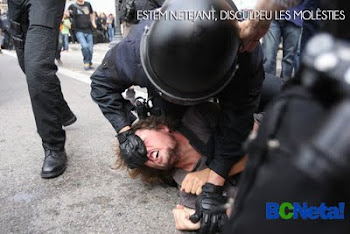
From the start, the government has reacted with violence, in an apparent desire to provoke responding violence in order to condemn the movement as violent.
An
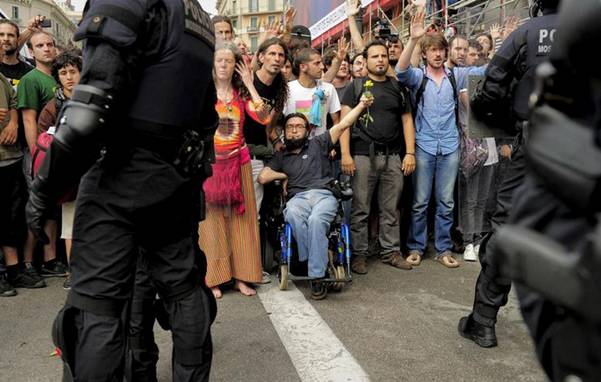
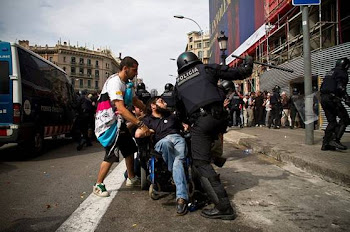
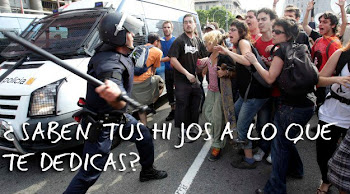
army of police, dressed like robots, have surrounded and blocked groups
of peaceful Yellow Vests, drowning them in clouds of teargas and firing
flash balls directly at protesters, seriously wounding hundreds (no
official figures). A number of people have lost an eye or a hand. The
government has nothing to say about this.
On
the third Saturday of protest, this army of police was unable to stop –
or under orders to allow – a large number of hoodlums or Black Blocs
(who knows?) infiltrate the movement and smash property, vandalize
shops, set fire to trash cans and parked cars, providing the world media
with images proving that the Yellow Vests are dangerously violent.
Despite
all this provocation, the Gilets Jaunes have remained remarkably calm
and determined. But there are bound to be a few people who lose their
tempers and try to fight back.
The Boxer
On
the 8th Saturday, January 5, a squad of plexiglass-protected police
were violently attacking Gilets Jaunes on a bridge over the Seine when a
big guy lost his temper, emerged from the crowd and went on the attack.
With his fists, he beat down one policeman and caused the others to
retreat. This amazing scene was filmed. You could see Yellow Vests
trying to hold him back, but Rambo was unstoppable.
It
turned out that this was Christophe Dettinger, a French Rom, former
light heavyweight boxing champion of France. His nickname is “the Gypsy
of Massy”. He got away from the scene, but made a video before turning
himself in. “I reacted badly”, he said, when he saw police attacking
women and other defenseless people. He urged the movement to go ahead
peacefully.

Dettinger faces seven years in prison. Within a day, his defense fund had gathered 116,433 euros. The government shut it down – on what legal pretext I don’t know. Now a petition circulates on his behalf.
The Slander
In
his New Year’s Eve address, Macron patronizingly scolded his people
telling them that “you can’t work less and earn more” – as if they all
aspired to spending their lives lounging on a yacht and watching stock
prices rise and fall.
Then he issued his declaration of war:
“These
days I have seen unthinkable things and heard the
unacceptable.” Apparently alluding to the few opposition politicians who
dare sympathize with the protesters, he chastised those who pretend to
“speak for the people”, but are only the “spokesmen for a hateful mob
going after elected representatives, police, journalists, Jews,
foreigners and homosexuals. It is simply the negation of France.”
The
Gilets Jaunes haven’t been “going after” anybody. The police have been
“going after” them. People have indeed spoken up vigorously against
camera crews of channels that systematically distort the movement.
Not a word has been heard from the movement against foreigners or homosexuals.
The key word is Jews.
Qui veut noyer son chien l’accuse de la rage. (French proverb).
As
the French saying goes, whoever wants to drown his dog claims he has
rabies. Today whoever wants to ruin a career, take vengeance on a rival,
disgrace an individual or destroy a movement accuses her, him, or it of
antisemitism.
So,
faced with a rising democratic movement, playing the “antisemitism”
card was inevitable. It was almost a sure thing statistically. In
almost any random batch of hundreds of thousands of people, you might
find one or two who have something negative to say about a Jew. That’ll
do it. The media hawks are on the outlook. The slightest incident can
be used to suggest that the real motive of the movement is to revive the
Holocaust.
This
gently ironic little song, performed on one of France’s traffic
circles, contrasts the “nice” establishment with the “bad” ordinary
folk. It is a huge hit on YouTube. It gives the tone of the
movement. Les Gentils et les Méchants.

It
didn’t take long for this merry number to be accused of
antisemitism. Why? Because it was ironically dedicated to two of the
very most virulent critics of the Gilets Jaunes: May ’68 star Daniel
Cohn-Bendit and old “new philosopher” Bernard-Henri Lévy. The new
generation can’t stand them. But wait, they happen to be Jewish. Aha!
Anti-Semitism!
The Repression
Faced
with what government spokesman Benjamin Griveaux described as
“agitators” and “insurrectionists” who want to “overthrow the
government”, Prime Minister Edouard Philippe announced a new “law to
better protect the right to demonstrate”. Its main measure: heavily
punish organizers of a demonstration whose time and place have not had
official approval.
In
fact, the police had already arrested 33-year-old truck driver Eric
Drouet for organizing a small candle ceremony in honor of the movement’s
casualties. There have been many other arrests, with no information
coming out about them. (Incidentally, over the holidays, hoodlums in the
banlieues of several cities carried out their ritual burning of parked
cars, with no particular publicity or crackdown. Those were cars of
working class people who need them to go to work, not the precious cars
in the rich section of Paris whose destruction caused such scandal.)
On
January 7, Luc Ferry, a “philosopher” and former Minister of Youth,
Education and Research, gave a radio interview on the very respectable
Radio Classique in which he declared: “The police are not given the
means to end this violence. It’s unbearable. Listen, frankly, when you
see guys kick a poor policemen when he’s down, that’s enough! Let them
use their arms once and for all, basta! […] As I recall, we have the
world’s fourth army, capable of putting an end to this garbage.”
Ferry called on Macron to make a coalition with the Republicans in order to push through his “reforms”.
Last
month, in a column against the Citizens’ Initiative Referendum, Ferry
wrote that “the current disparaging of experts and criticism of elitism
is the worst calamity of our times.”
The Antifa
Wherever
people gather, Antifa groups may pursue their indiscriminate search to
root out “fascists”. In Bordeaux last Saturday, Yellow Vests had to
fight off an attack by Antifa.
It
is now completely clear (as indeed it always has been) that the
self-styled “Antifascists” are the watch dogs of the status quo. In
their tireless search for “fascists”, the Antifa attack anything that
moves. In effect, they protect stagnation. And curiously enough, Antifa
violence is tolerated by the same State and the same police who insult,
attack and arrest more peaceful demonstrators. In short, the Antifa are
the storm troopers of the current system.
The Media
Be
skeptical. At least in France, mainstream media are solidly on the side
of “order”, meaning Macron, and foreign media tend to echo what
national media write and say. Also, as a general rule, when it comes to
France, the Anglophone media often get it wrong.
The End
It
is not in sight. This may not be a revolution, but it is a revelation
of the real nature of “the system”. Power lies with a technocracy in
the service of “the Markets”, meaning the power of finance capital.
This technocracy aspires to remake human society, our own societies and
those all over the planet, in the interests of a certain capitalism. It
uses economic sanctions, overwhelming propaganda and military force
(NATO) in a “globalization” project that shapes people’s lives without
their consent. Macron is the very embodiment of this system. He was
chosen by that famous elite to carry through the measures dictated by
“the Markets”, enforced by the European Union. He cannot give in. But
now that people are awake to what is going on, they won’t stop either.
For all the lamented decline in the school system, the French people
today are as well-educated and reasonable as any population can be
expected to be. If they are incapable of democracy, then democracy is
impossible.
To be continued…
*
Note
to readers: please click the share buttons above. Forward this article
to your email lists. Crosspost on your blog site, internet forums. etc.
Diana Johnstone is the author of Fools’ Crusade: Yugoslavia, NATO, and Western Delusions. Her new book is Queen of Chaos: the Misadventures of Hillary Clinton. The memoirs of Diana Johnstone’s father Paul H. Johnstone, From MAD to Madness, was published by Clarity Press, with her commentary. She can be reached at diana.johnstone@wanadoo.fr. Diana Johnstone is a Research Associate of the Centre for Research on Globalization (CRG).