Canada’s Energy Board shows disregard for Tribal concerns in second decision to green-light pipeline

A Canadian federal agency today formally recommended approval of the Trans Mountain Pipeline Expansion, a move strongly condemned by Coast Salish Tribes on both sides of the U.S.-Canada border.
In November 2018, representatives from U.S. Coast Salish Tribes joined Canadian First Nations in Victoria, British Columbia, to testify before Canada’s National Energy Board as part of a review of the proposed pipeline expansion.
Despite testimony and legal arguments presented by First Nations and U.S. Tribes describing the significant harms the pipeline expansion project will cause for their communities, the Canadian federal government made a determination to push ahead with the project. The Trans Mountain expansion will triple oil tanker traffic through the Salish Sea — imperiling endangered orcas, increasing navigation risks for fishermen, and increasing the risk of a major oil spill.
“The NEB found that the Trans Mountain Pipeline will harm Indigenous people and endangered orcas, but it still recommended the project,” said Stephanie Tsosie, an Earthjustice attorney representing the U.S. Tribes before the Energy Board. “It has twisted the definition of public interest to sacrifice the Salish Sea, the people who rely on it, and even the air we breathe.”

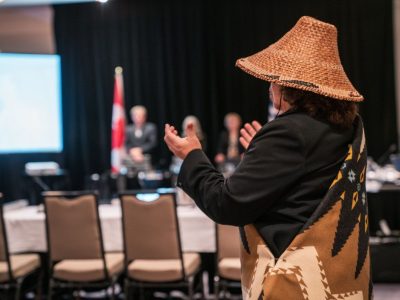
Tulalip Chairwoman Marie Zackuse, Suquamish Chairman Leonard Forsman, Lummi Hereditary Chief Bill James, Swinomish Senator Brian Wilbur, and Swinomish Senator Jeremy James Wilbur lead U.S. Coast Salish tribal members into a hearing before the Canadian National Energy Board in November 2018 in Victoria, British Columbia. (Source: ALEX HARRIS FOR EARTHJUSTICE)
Quotes from US Coast Salish Tribes
“We are in danger of losing our relatives the southern resident killer whales,” said Lisa Wilson of the Lummi Nation. “We know the impact of vessel traffic, we know the impact of the noise, and we know what the impact would be if there is an oil spill — the major devastation that’s going to wipe out all of the species in the Salish Sea.”“Salmon is one of the resources that has sustained our people since time immemorial,” said Swinomish Senator Jeremy James Wilbur. “We’ve always relied on salmon, clams, halibut, shrimp, prawns, diving. Usual and accustomed fishing areas are places our tribes have fished for many, many generations. And to impact that would be a major disaster.”“We are very concerned about the Trans Mountain Pipeline’s impact on the orcas, and also on the rest of the food chain in the Salish Sea,” noted Chairman Leonard Forsman of the Suquamish Tribe. “Everything interrelates. The orca’s just an alarm bell — there are other places where we have a lot of other problems with salmon habitat, shellfish habitat, water quality and all those things that impact the food web. Also, the promotion of fossil fuel use and combustion will contribute more to climate change, which is bringing warming waters and raising sea levels.”“You don’t poison where you get your food. You just don’t do that,” said Noel Purser, of the Suquamish Tribe. “I understand in British Columbia, this pipeline will provide a way of having an income. But is it worth the potential of a spill, that risk? Is it really worth that? Because that will impact everybody, not just here in British Columbia. It will impact us in Suquamish; it will impact our relatives in Alaska.”“As Coast Salish people, we do not recognize the imaginary line that divides us from First Nation relatives,” said Chairwoman Marie Zackuse, from the Tulalip Tribes. “The Salish Sea does not recognize this border. Our relatives, the salmon and the killer whales do not recognize this border. Pollution, industrial waste, and climate change do not recognize this border. Impacts to these species are felt throughout the Salish Sea on both sides of the border, and they are cumulative effects. This Trans Mountain expansion may just be the project that brings us past the point of no return.”
The National Energy Board decision disregarded these and other comments shared during the November 2018 oral testimony. For media interviews, reporters should reach out to Tribal contacts listed above.

The proposed tar sands pipeline expansion is one of several projects that would dramatically increase the passage of tankers and bulk carriers through the Salish Sea on both sides of the U.S.-Canada border.
Background
In 2013, four Northwest U.S. Tribes — the Swinomish Indian Tribal Community, Tulalip Tribes, Suquamish Tribe, and Lummi Nation — intervened in Canadian permit proceedings over the new tar sands pipeline, joining scores of Canadian First Nations and conservationists, the cities of Vancouver and Burnaby, and the Province of British Columbia in opposition to the pipeline. The U.S. Tribes’ position before Canada’s National Energy Board represented a critical call to safeguard the Salish Sea from increased oil tanker traffic and greater risk of oil spills.
The Trans Mountain Pipeline Project calls for tripling the amount of oil shipped from tar sands fields in Alberta to approximately 890,000 barrels per day to the British Columbia coast. The pipeline would cause an almost seven-fold increase in oil tankers moving through the shared waters of the Salish Sea, paving way for an increase in pollution, noise, groundings, accidents, and oil spills.
The proposed tar sands pipeline expansion is one of several projects that could dramatically increase the passage of tankers and bulk carriers through the Salish Sea on both sides of the U.S.-Canada border.
*
Note to readers: please click the share buttons below. Forward this article to your email lists. Crosspost on your blog site, internet forums. etc.
Featured image: Tulalip Tribes Chairwoman Marie Zackuse before addressing Canada’s National Energy Board. (Source: ALEX HARRIS FOR EARTHJUSTICE)
The original source of this article is Earth Justice
Copyright © Earth Justice, Earth Justice, 2019