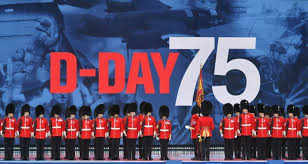
The decision not to invite President Putin to attend the 75th D-Day commemoration event was a civilizational provocation aimed at dividing the European Allies during World War II and reinforcing the historically revised notion that the Soviet Union was an “accidental ally” during the conflict.
Over a dozen world leaders assembled on Wednesday in the British city of Portsmouth to commemorate the 75th anniversary of the Allied D-Day invasion of Nazi-occupied Western Europe, which was an event of historical importance for all the continent’s people and therefore part of their shared memory. That’s why even the leaders of Poland and Slovakia, whose countries were liberated by the Red Army and not by the forces that took part in D-Day, were invited to attend, though the decision to not invite President Putin was a civilizational provocation of epic proportions. There’s been an ongoing trend for quite a while of historically revising the events of World War II in order to minimize the Soviet Union’s enormous contribution to defeating fascism, which when taken to its natural conclusion aims to portray the USSR as an “accidental ally” during the conflict and even a one-time “aggressor state” that supposedly only joined the Allies after Hitler betrayed Stalin during Operation Barbarossa.
In reality, however, the Soviet Union was imploring its European counterparts to take the rising Nazi threat seriously all throughout the 1930s but was repeatedly rebuffed out of the paranoid fear that the USSR’s warnings were just a “conspiracy theory” designed to get them to collectively destroy the only nation capable standing in the way of the “communist domination of Europe”. The subsequent Old Cold War that settled over the continent almost immediately after the Nazis were defeated was manipulated by the Western governments in such a way as to blame the Soviet Union and retroactively “vindicate” their decision not to team up with it against Hitler a decade prior before tens of millions of people were slaughtered by the fascist war machine. Instead of disappearing after the end of the Old Cold War, this narrative continued into the present and was actually “reinforced” by the new notion that Stalin was supposedly just as bad as Hitler.
Proponents of this interpretation always point to the Molotov-Ribbentrop Pact in alleging that the USSR was a one-time “aggressor state” that only “accidentally” joined the Allies after Hitler’s betrayal. This simplistic point, however, completely ignores the fact that none other than Stalin himself tried to assemble a continental coalition against the fascist threat all throughout the 1930s and only cut a pragmatic deal with the Nazis in order to buy time for the inevitable clash that he expected to have with them sometime in the coming future, albeit one that his country was prepared to fight alone when the moment arrived after seeing how unwilling Europe hitherto was in allying with him against Hitler. Seeing as how the Soviet Union was the first one to warn about the fascist threat and suffered the most during the war, it’s nothing less than a provocation not to invite the leader of its political successor to the 75th D-Day commemorative event that’s become part of Europe’s collective memory.
The grand strategic intent behind this malicious slight wasn’t just to pettily insult President Putin and his people personally, but to divide the European Allied camp during World War II into two opposing sides that supposedly continue to confront one another to this day. The inclusion of the Polish and Slovak leaders wasn’t incidental either, as their countries were liberated by the Red Army, formed part of the Eastern Bloc for decades, but are nowadays proud NATO members. With this observation in mind, it convincingly appears as though the 75th D-Day commemorative event was meant to celebrate NATO’s formation more so than the liberation of Europe from Nazi control, which was itself mostly achieved through the sacrifices of the Soviet Union and its allied partisan fighters. In civilizational terms, the implicit message is that neither the Soviet Union nor the modern-day Russian Federation are part of European civilization but are instead something else entirely.
While Russians themselves debate whether their country is European, Asian, or Eurasian, the historic fact is that Russia has consistently played a decisive role in European history over the centuries, especially when it came to defeating the Swedes, Poles, Napoleon, and Hitler, so pretending that it isn’t a part of European civilization is very dishonest but cynically “justifies” the post-2014 military build-up of NATO’s forces (conceived in this historically revisionist paradigm as the successor of the “true” European Allied coalition) along Russia’s borders. This is extremely dangerous because it sets the stage for framing the New Cold War as a “Clash of Civilizations” between the West and Russia, thus implying that it’ll continue for the indefinite future and be seen as an existential struggle by the US and its allies, one that might radicalize its populations with Russophobia and therefore make the possibility of an eventual rapprochement all the more difficult to achieve.
*
Note to readers: please click the share buttons above or below. Forward this article to your email lists. Crosspost on your blog site, internet forums. etc.
Andrew Korybko is an American Moscow-based political analyst specializing in the relationship between the US strategy in Afro-Eurasia, China’s One Belt One Road global vision of New Silk Road connectivity, and Hybrid Warfare. He is a frequent contributor to Global Research.
The original source of this article is Global Research
Copyright © Andrew Korybko, Global Research, 2019