- Yield curve, credit conditions can provide early warnings
- Some manufacturing and employment data can also prove useful

As the U.S. nears a record-long expansion in July, the conversation is increasingly turning to when it will all end.
Recessions are inherently hard to spot. The National Bureau of Economic Research’s Business Cycle Dating Committee, a panel whose determinations of when expansions begin and end are accepted as official, generally waits about a year to make a call. By the time a sustained downturn is evident in data like payrolls or gross domestic product, a contraction may have already begun.
Recession fears ebbed Friday as solid retail sales suggested consumer spending remains healthy. But investors still expect a Federal Reserve interest-rate cut in July after other recent figures showed slower job gains and low inflation, while President Donald Trump’s tariff threats weigh on businesses. And the chance of a recession over the next 12 months has risen to 30% from 25%, according to a June 7-12 survey of economists.
Economists look to a wide range of data -- from government, private and market sources -- to try to figure out just when things are headed downhill. Here’s a sampling:
Yield Curve
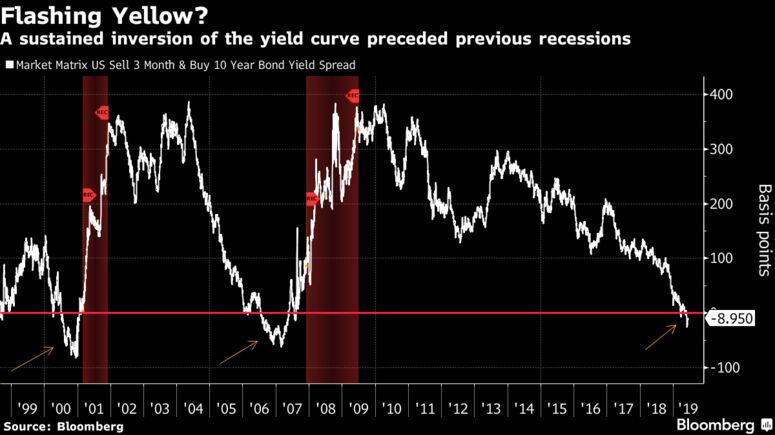
The yield curve refers to the difference in rates between Treasuries with short-term and long-term maturities. Most of the time, long-term yields are higher because investors typically demand higher returns for locking up their money for a longer period. But when short-term rates are higher -- known as an “inverted” curve -- it’s a sign economic growth is expected to ebb, with policy rates eventually falling to cushion the slowdown.
The spread between three-month and 10-year securities has inverted before each of the last seven recessions, elevating such an event as a key signal of a future economic downturn. But it’s not automatic, and some argue central bank policies like quantitative easing have made the curve less of a direct predictor.
Credit Conditions
Another weather vane monitored by economists consists of whether borrowing conditions are getting tougher, especially for small- and medium-sized businesses. Surveys such as the Fed’s poll of senior loan officers and the National Federation of Independent Business’s gauge of credit conditions relay this type of information.
“If banks are tightening the spigot because of what they see as excesses out there and increasing risks and that sort of thing, that tends to be a leading indicator,” said Joshua Shapiro, chief U.S. economist at MFR Inc.
Business Sentiment
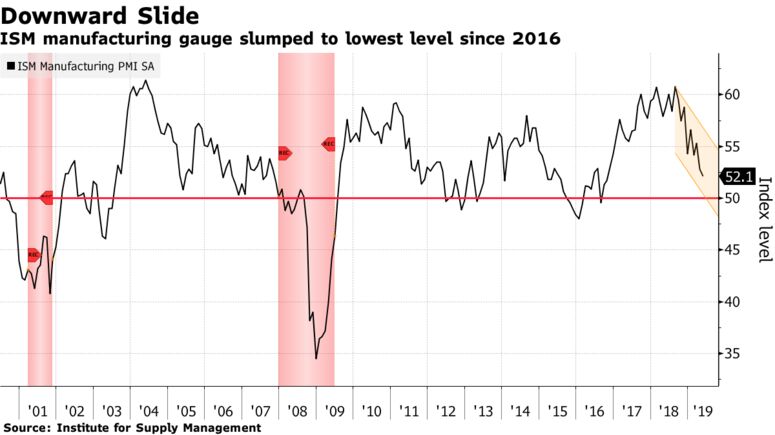
Surveys like those from the Institute for Supply Management offer a snapshot of economic activity among producers. In May, ISM’s manufacturing index fell to its lowest level since 2016 but still held above the 50 mark that indicates expansion.
The downward trend suggests “there’s been a lingering caution on behalf of businesses,” said Jesse Edgerton, senior economist at JPMorgan Chase & Co. “We have seen that already playing out in declines in capital expenditures, and then I think the big concern is whether it further turns into a slowdown in hiring.”
The ISM survey also contains some sub-indicators that can provide a look at what’s likely to happen like new orders and backlogs, while anecdotes in the report can flag risks like slowing demand or the negative impact of tariffs. Slow orders can precede layoffs if companies already have slack -- or can be manageable if production is already stretched.
Still, manufacturing contracted in 2015 and early 2016 without pushing the economy into a recession.
Labor Signs
Monthly payroll data is often described as a coincident indicator -- it does a good job at showing the health of the labor market in any given month. But by the time companies stop creating jobs or are even possibly laying off workers, economic weakness has already set in.
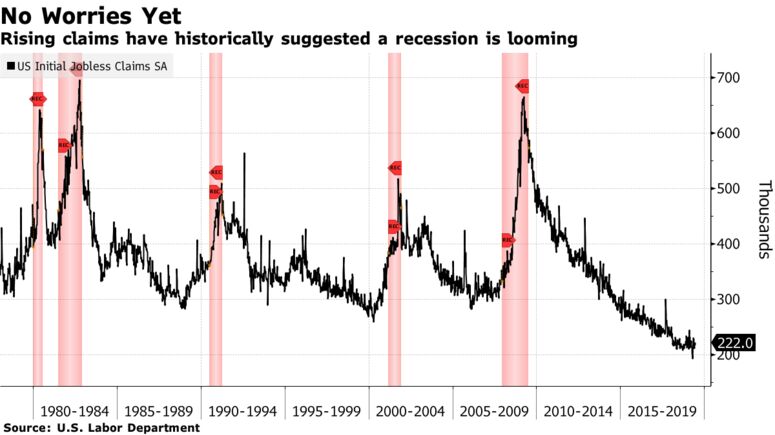
Initial jobless claims show how many Americans are applying to receive unemployment benefits and can give a sense of where the economy is headed. A significant and sustained pick-up in jobless claims suggests companies are boosting layoffs and a recession could be fast approaching.
A related leading indicator is temporary hiring. The logic goes: When times are good, businesses may recruit temporary hires to meet demand. When times are bad, temporary hires are often the first to go.
“As long as consumers and services hold, the economy holds,” said Simona Mocuta, senior economist at State Street Global Advisors.
— With assistance by Liz McCormick, Rich Miller, and Catarina Saraiva