“La sabiduría de la vida consiste en la eliminación de lo no esencial. En reducir los problemas de la filosofía a unos pocos solamente: el goce del hogar, de la vida, de la naturaleza, de la cultura”.
Lin Yutang
Cervantes
Hoy es el día más hermoso de nuestra vida, querido Sancho; los obstáculos más grandes, nuestras propias indecisiones; nuestro enemigo más fuerte, el miedo al poderoso y a nosotros mismos; la cosa más fácil, equivocarnos; la más destructiva, la mentira y el egoísmo; la peor derrota, el desaliento; los defectos más peligrosos, la soberbia y el rencor; las sensaciones más gratas, la buena conciencia, el esfuerzo para ser mejores sin ser perfectos, y sobretodo, la disposición para hacer el bien y combatir la injusticia dondequiera que esté.
MIGUEL DE CERVANTES Don Quijote de la Mancha.
La Colmena no se hace responsable ni se solidariza con las opiniones o conceptos emitidos por los autores de los artículos.
17 de octubre de 2019
Scientists Propose New Satellite Tech to Dodge Space Junk from Megaconstellations
If a disastrous space junk
chain reaction ends up surrounding Earth with a belt of destructive
shrapnel, state-of-the-art infrared cameras and gel-based rockets just
might help future satellites dodge such debris, a new study finds.
Space
debris might not sound dangerous until one realizes that in low Earth
orbit — up to about 1,200 miles (2,000 kilometers) in altitude — such
debris collides with an average speed of about 22,370 mph (36,000 km/h),
according to NASA. At such speeds, even tiny pieces of space debris can inflict devastating damage.
Collisions
with space debris have already led to millions of dollars in losses.
For example, on Feb. 10, 2009, an active U.S. communications satellite
called Iridium 33 was obliterated when it was struck by a defunct Russian satellite Cosmos 2251 built in the 1960s.
In
addition, such disasters can generate more debris that could go on to
destroy more objects in orbit, a cascade of destruction that might
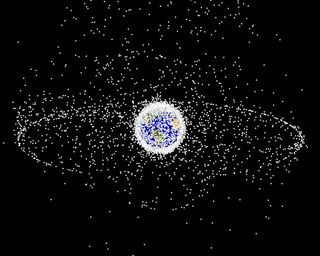
ultimately create a debris belt around Earth. This worst-case
chain-reaction scenario is known as the "Kessler effect" or "Kessler
syndrome," a scenario that NASA scientist Donald Kessler predicted in 1978. Video:The Global Threat of Space Debris Related:7 Wild Ways to Clean Up Space Junk
The Rise of megaconstellations
Currently
about 500,000 marble-size pieces of debris and more than 100 million
objects a millimeter or less in size are estimated to orbit Earth, according to NASA.
Furthermore, since it has become cheaper than ever to build and launch
satellites, companies such as SpaceX, Amazon, OneWeb and Telesat are
planning to launch "megaconstellations" into low Earth orbit in the next
few years, and each will be composed of hundreds of miniature
satellites.
A study in 2017
suggested the collisions one might expect to occur with such
megaconstellations might significantly exacerbate the risk of the
Kessler effect. In fact, the European Space Agency had to move its
Aeolus Earth-observation satellite on Sept. 2 to avoid a potential
collision with a SpaceX Starlink satellite, one of 60 such satellites launched at the same time in May of this year.
To
prepare for the possibility of the Kessler effect, scientists analyzed
how satellites might continue to survive and operate when space debris
dominates low Earth orbit.
"Given how a whole bunch of companies
are now proposing megaconstellations that would cram up to thousands of
satellites into low Earth orbit, it's not a matter of if but when these
things start to collide and cause this ripple effect of accidents,"
Jekan Thangavelautham, an aerospace engineer at the University of
Arizona, told Space.com. Thangavelautham is senior author of the new
study on space debris, which he and colleagues presented on Sept. 18 at the Advanced Maui Optical and Space Surveillance Technologies Conference in Hawaii. Related: European Satellite Dodges Potential Crash with SpaceX Starlink Craft
Avoiding the Kessler syndrome
When
it comes to miniature bits of space debris, prior work suggested that
satellites could get protected using defenses known as Whipple shields.
These
consist of a relatively thin cover over the main wall of a spacecraft,
which breaks up and disperses incoming debris. This spreads the energy
of the impact over a larger area, making it easier to withstand.
However, Whipple shields can only protect against debris 0.4 inches (1
centimeter) wide or smaller, the researchers said.
For big chunks
of space debris, ground-based radar and telescopes can remotely track
their movements, helping scientists predict their trajectories.
Satellites can then get instructed on how to best maneuver to prevent
impacts. However, such "remote avoidance" strategies are limited,
because NASA and the Department of Defense cannot track objects smaller
than 2 inches (5 cm) in size, the new study noted.
The scientists
focused on how satellites might deal with debris too small to be tracked
from the ground yet big enough to penetrate Whipple shields. They
suggested that an onboard thermal infrared camera might help a satellite
quickly detect minuscule levels of heat from this mid-size debris on
the scale of tens of miles away, all without any input from the ground.
However,
even if a satellite could detect incoming space junk from tens of miles
away, given the speed at which orbital debris travels, satellites would
only have seconds to dodge a collision. The researchers suggested using
rockets that use solid propellants, as these are high-thrust,
lightweight and reliable, and can activate in a fraction of a second —
all for a fast, rough push out of harm's way.
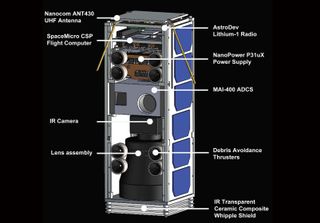
Space junk-dodging cubesat
An illustration of a concept cubesat equipped with gel-based thrusters and infrared cameras to track space junk.
(Image credit: Troy M. Jameson and Himangshu Kalita)
To
test their ideas, the scientists proposed developing a cubesat — a
satellite based on cubes just about 4 inches (10 cm) wide. They
suggested creating a breadloaf-size cubesat the size of three such cubes
with 16 solid-propellant thrusters and a thermal infrared camera with a
ceramic Whipple shield transparent to infrared rays.
"We want to keep the design fundamentally simple, for a system that doesn't cost an arm and a leg," Thangavelautham said.
The
most common type of solid-propellant rockets can each be used only
once. Part of the reason the researchers' proposed avoidance system has
multiple thrusters is so that it can help a satellite evade multiple
potential collisions if necessary.
Alternatively, there are
rockets that use solid gels as propellant instead that can each fire
many times — "these could increase the number of times a satellite could
dodge debris," Thangavelautham said.