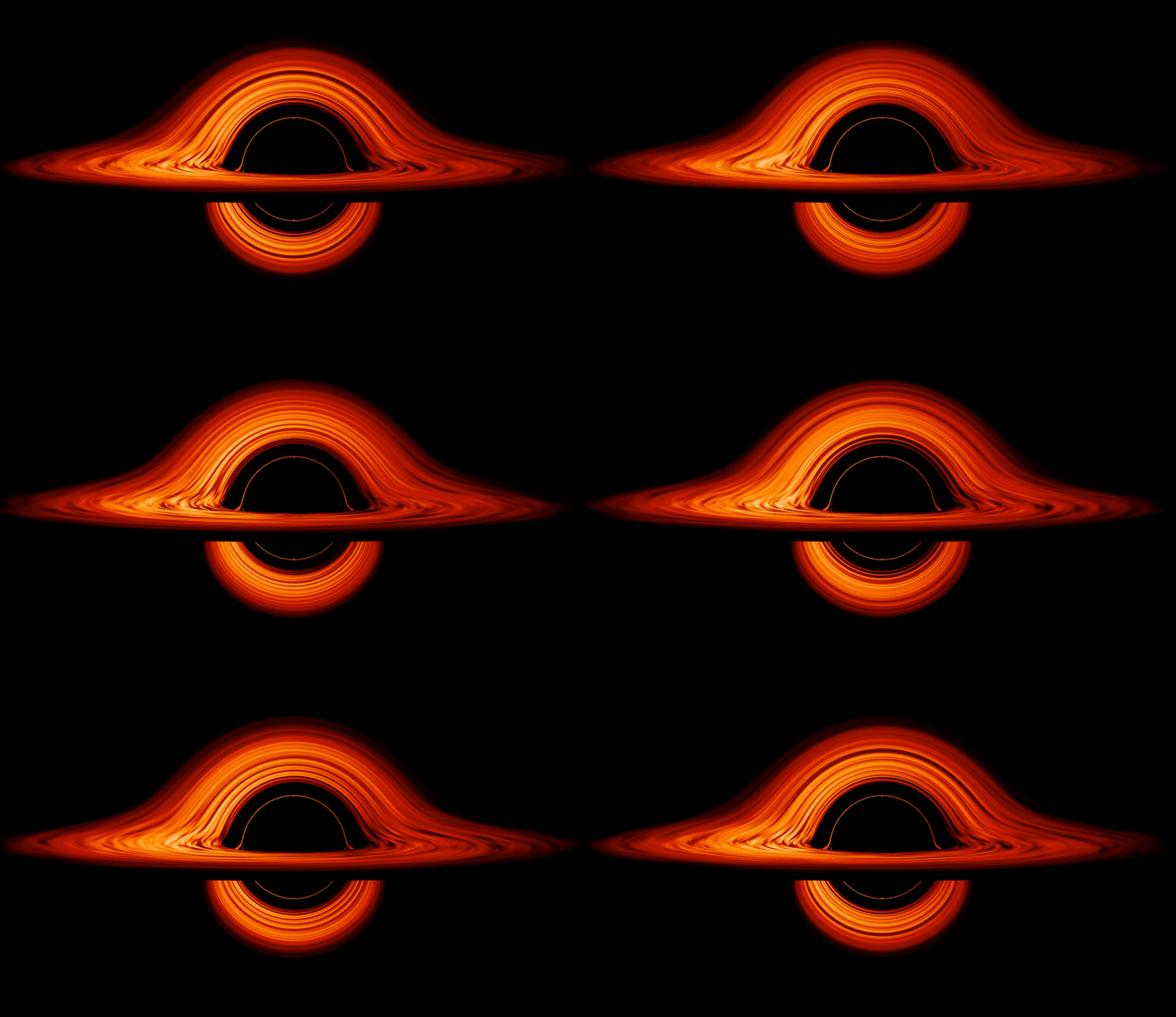
(Image: © Jeremy Schnittman/NASA's Goddard Space Flight Center)
But as it turns out, black holes are more than just cosmic vacuum cleaners. In 2019, physicists peered into the fathomless darkness and snapped the first-ever picture of a black hole. They also learned more about how these bizarre and insatiable beasts work. From their propensity to gain and lose hair, to their mysterious innards, to where they may lead, here are 14 new things we learned about black holes in 2019.
Related: 9 Ideas About Black Holes That Will Blow Your Mind
An unforgettable image
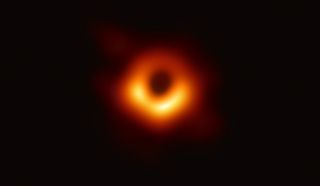
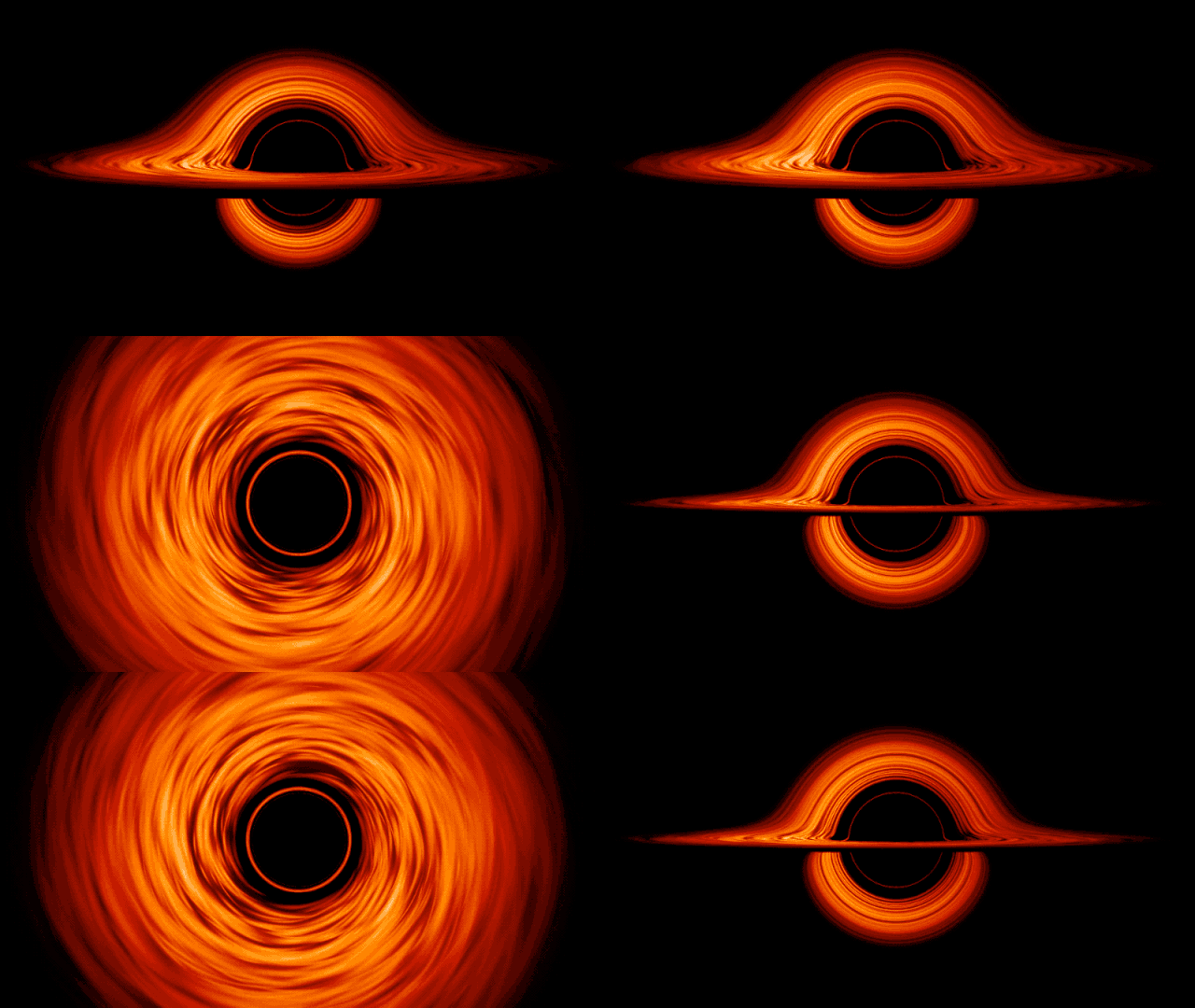
The fiery orange glow surrounding its black heart demarcates its event horizon, the ring of matter that swirls around a black hole just before falling in. As it rubs against other matter at high speeds, it produces energy and glows to form an accretion disk — hence the orange ring.
Black holes grow hair, then grow bald again
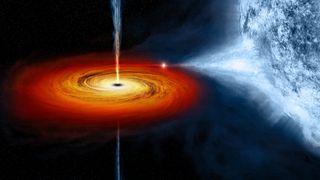
But in 2016, late physicist Stephen Hawking, along with others, published a paper proposing that black holes have "hair," or distinctive features. These hairs were subtle shifts in the event horizon, as well as the Cauchy horizon — the point at which cause and effect flip — that would make black holes distinguishable from each other. At least, as a 2018 study claimed, that was the case for so-called "extreme" black holes, or those with maximum electric charge. Earlier this year, physicists found that even the not-so-extreme ones — those spinning at near-maximum speed, but with no charge, or those with a maximum possible charge, but with no rotation — might also have hair.
But as it turns out, black holes fleetingly sprout a few tufts of wispy "hair," all of which they eventually lose, Live Science reported at the time.
Right now, the question of whether black holes are more like Mr. T or Heather Locklear is pure speculation. But the world's largest gravitational-wave detector could soon find evidence to support one theory over another, experts say.
Impossibly big black hole
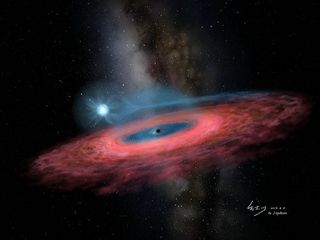
"This discovery forces us to re-examine our models of how stellar-mass black holes form," Laser Interferometer Gravitational-Wave Observatory (LIGO) director and University of Florida professor David Reitze, who was not involved in the study, said in a statement at the time.
About that impossible black hole...
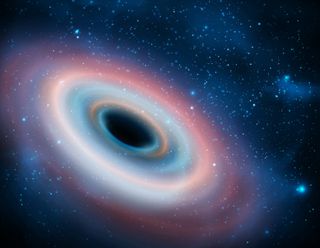
The impossibly big black hole was probably just a regular-size black hole, and the research team that initially crunched the numbers simply made a mistake in interpreting the light emissions coming from the black-hole/star binary system. By muddling the light from the companion star with the faint emissions that would come from the black hole's accretion disk, or the ring of matter circling its mouth, the researchers had overestimated the black hole's mass by at least twofold, the studies posted to arXiv found.
Black holes as galactic life givers
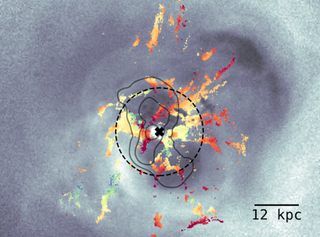
But there may be more to these stone-faced cosmic killers. Black holes may actually be the engines of life for galaxies. In their eating frenzies, black holes also send bubbles of scorching-hot, turbulent gas through the cosmos, according to a November study. That hot plasma may be keeping alive galaxies that would otherwise cool off and die, the study found. Another study, published in May, found that the radiation emitted by black holes could power alien life — as long as it exists in a Goldilocks zone not too far, and not too close, to the center of the galaxy. As these black holes feed, their radiation and light may power photosynthesis and facilitate the formation of the biomolecular building blocks of life, that study found.
Black holes may not be black holes at all
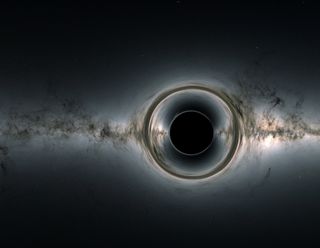
According to Einstein, black holes are infinitely small, infinitely dense specks known as a singularity, where the math of general relativity breaks down. But according to the new research, a common mathematical simplification used to analyze the theory of relativity may have a flaw. As a result, black holes may not be singularities at all. Instead, they may be pockets of space stuffed with dark energy. And that could explain some surprising findings from the world's largest gravitational-wave hunter.
Mini black holes exist
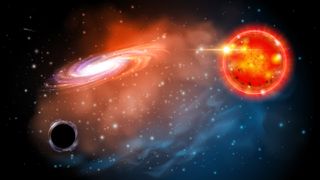
In November, astronomers peering at the fringes of the Milky Way, about 10,000 light-years away, found faint evidence for a black hole about 3.3 times as massive as the sun. That's far too big to be a neutron star, but smaller than any known black hole. Such black holes were predicted, but had never been spotted before.
Milky Way's black hole has a flare
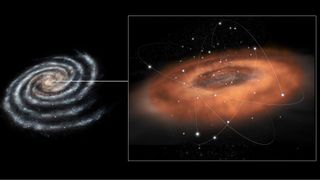
Then, astronomers noticed a strange flare, with the black hole glowing the brightest astronomers had ever seen, at least in the infrared spectrum.
It's not clear what that strange flare is, but scientists think the flare was caused when a dusty object or star had a close shave with Sagittarius A*.
The biggest black holes formed in a snap
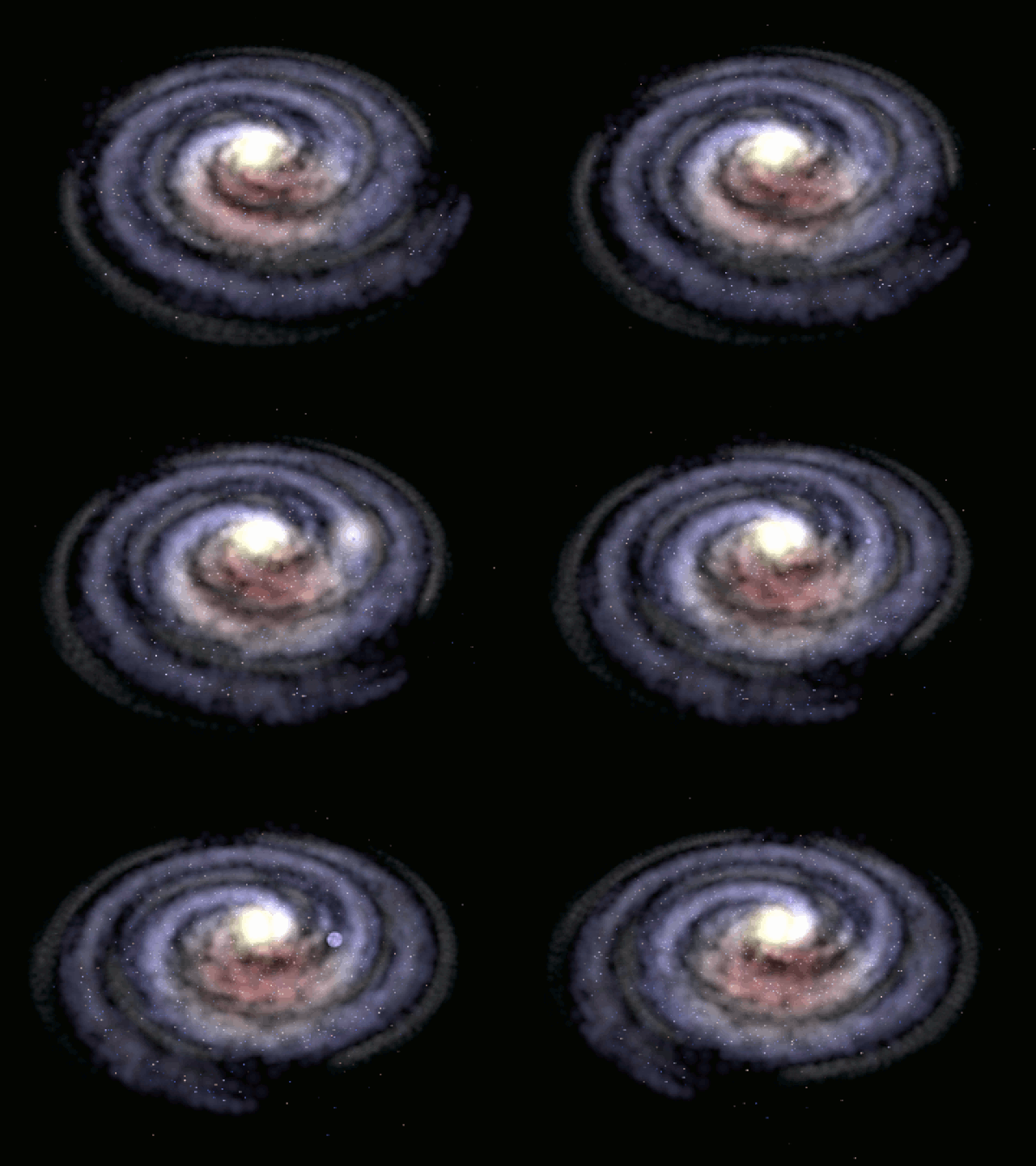
A study published in June suggested that supermassive black holes could have formed in the first 800 million years of the universe's history — and all it would have taken was a large gas cloud. As gas clouds accumulated and bound gravitationally, they would have collapsed under their own weight, forming a small black hole without any need for a star going supernova. These so-called "direct-collapse black holes" would then have continued to hoover up matter at a blistering pace, growing 10,000-fold over the span of just 150 million years.
At that point, they just stopped — leaving behind the supermassive black holes dotting our universe today.
UFOs fly out of black holes
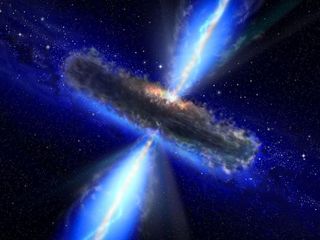
A study published in August found that these UFOs may explain why the space near the heart of galaxies is relatively lacking in matter. UFOs from supermassive black holes at galactic centers may act like snowplows, shoving all the extra matter in the immediate vicinity of a black hole farther away from its periphery, the study found.
Planet 9 may actually be a black hole
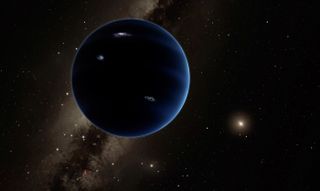
There are some strange objects, way out past Neptune, that behave as if they're being governed by the gravity of some nearby object that we can't see. They orbit away from the other eight planets and they seem to be oriented in a different plane.
Some theorists have done calculations and concluded that there's a planet out there — with a wonky orbit — that's about 10 to 20 times the mass of Earth. But in a study published in October, other scientists who had done separate number crunching found that a tiny primordial black hole, about as big as a grapefruit, could also explain the weird behavior of these trans-Neptunian objects.
Sending messages through a black hole would make it evaporate
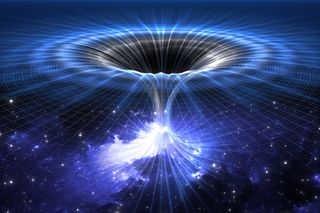
In August, scientists found that sending even a tiny message through a black hole would alter the black hole, making it evaporate. The first message to be transmitted through the wormhole would shrink the receiving black hole by 30%, and each subsequent message would shrink the black hole further — while carrying less and less information. After just a handful of transmissions, the message would carry no information and the receiving black hole would disappear.
Aliens could shoot lasers at black holes
We may be able to rescue you from a black hole
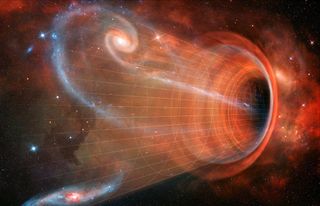
According to that theory, there may be a way to entangle two black holes. (Quantum entanglement is the strange effect, typically only seen at tiny subatomic scales, in which two particles or objects are inextricably linked across vast distances.) No one has ever managed to entangle objects that are visible to the naked eye, but assuming there was a way to entangle two objects as massive as black holes, it may be possible to use them as a way to instantly teleport between two locations. In which case, if you accidentally fell into a black hole, there may be a way to get you out — albeit in another time and place.
Spinning black holes could make for gentle hypersonic travel
Let's assume that wormholes exist, and that black holes are the way into them. Certain types of supermassive black holes, such as the gentle giant at the heart of our galaxy, don't rotate very much. And new calculations suggest that traveling into such a black hole wouldn't even make for a bumpy ride, because its slow-going rotation would mean negligible shrinking and stretching, and would be well within the range of stresses a spaceship could handle.
- What's That? Your Physics Questions Answered
- The 12 Strangest Objects in the Universe
- Cosmic Record Holders: The 12 Biggest Objects in the Universe
Black holes are dark spots in the fabric of space-time, incredibly dense singularities with such strong gravity that nothing can escape their clutches. They spend their time doing one thing: gobbling up matter. Get close enough to a black hole, and you're cosmic spaghetti, stretched to bits, sucked inward, never to return. Simple and straightforward, right?
But as it turns out, black holes are more than just cosmic vacuum cleaners. In 2019, physicists peered into the fathomless darkness and snapped the first-ever picture of a black hole. They also learned more about how these bizarre and insatiable beasts work. From their propensity to gain and lose hair, to their mysterious innards, to where they may lead, here are 14 new things we learned about black holes in 2019.
Related: 9 Ideas About Black Holes That Will Blow Your Mind
An unforgettable image
The fiery orange glow surrounding its black heart demarcates its event horizon, the ring of matter that swirls around a black hole just before falling in. As it rubs against other matter at high speeds, it produces energy and glows to form an accretion disk — hence the orange ring.
Black holes grow hair, then grow bald again
But in 2016, late physicist Stephen Hawking, along with others, published a paper proposing that black holes have "hair," or distinctive features. These hairs were subtle shifts in the event horizon, as well as the Cauchy horizon — the point at which cause and effect flip — that would make black holes distinguishable from each other. At least, as a 2018 study claimed, that was the case for so-called "extreme" black holes, or those with maximum electric charge. Earlier this year, physicists found that even the not-so-extreme ones — those spinning at near-maximum speed, but with no charge, or those with a maximum possible charge, but with no rotation — might also have hair.
But as it turns out, black holes fleetingly sprout a few tufts of wispy "hair," all of which they eventually lose, Live Science reported at the time.
Right now, the question of whether black holes are more like Mr. T or Heather Locklear is pure speculation. But the world's largest gravitational-wave detector could soon find evidence to support one theory over another, experts say.
Impossibly big black hole
"This discovery forces us to re-examine our models of how stellar-mass black holes form," Laser Interferometer Gravitational-Wave Observatory (LIGO) director and University of Florida professor David Reitze, who was not involved in the study, said in a statement at the time.
About that impossible black hole...
The impossibly big black hole was probably just a regular-size black hole, and the research team that initially crunched the numbers simply made a mistake in interpreting the light emissions coming from the black-hole/star binary system. By muddling the light from the companion star with the faint emissions that would come from the black hole's accretion disk, or the ring of matter circling its mouth, the researchers had overestimated the black hole's mass by at least twofold, the studies posted to arXiv found.
Black holes as galactic life givers
But there may be more to these stone-faced cosmic killers. Black holes may actually be the engines of life for galaxies. In their eating frenzies, black holes also send bubbles of scorching-hot, turbulent gas through the cosmos, according to a November study. That hot plasma may be keeping alive galaxies that would otherwise cool off and die, the study found. Another study, published in May, found that the radiation emitted by black holes could power alien life — as long as it exists in a Goldilocks zone not too far, and not too close, to the center of the galaxy. As these black holes feed, their radiation and light may power photosynthesis and facilitate the formation of the biomolecular building blocks of life, that study found.
Black holes may not be black holes at all
According to Einstein, black holes are infinitely small, infinitely dense specks known as a singularity, where the math of general relativity breaks down. But according to the new research, a common mathematical simplification used to analyze the theory of relativity may have a flaw. As a result, black holes may not be singularities at all. Instead, they may be pockets of space stuffed with dark energy. And that could explain some surprising findings from the world's largest gravitational-wave hunter.
Mini black holes exist
In November, astronomers peering at the fringes of the Milky Way, about 10,000 light-years away, found faint evidence for a black hole about 3.3 times as massive as the sun. That's far too big to be a neutron star, but smaller than any known black hole. Such black holes were predicted, but had never been spotted before.
Milky Way's black hole has a flare
Then, astronomers noticed a strange flare, with the black hole glowing the brightest astronomers had ever seen, at least in the infrared spectrum.
It's not clear what that strange flare is, but scientists think the flare was caused when a dusty object or star had a close shave with Sagittarius A*.
The biggest black holes formed in a snap
A study published in June suggested that supermassive black holes could have formed in the first 800 million years of the universe's history — and all it would have taken was a large gas cloud. As gas clouds accumulated and bound gravitationally, they would have collapsed under their own weight, forming a small black hole without any need for a star going supernova. These so-called "direct-collapse black holes" would then have continued to hoover up matter at a blistering pace, growing 10,000-fold over the span of just 150 million years.
At that point, they just stopped — leaving behind the supermassive black holes dotting our universe today.
UFOs fly out of black holes
A study published in August found that these UFOs may explain why the space near the heart of galaxies is relatively lacking in matter. UFOs from supermassive black holes at galactic centers may act like snowplows, shoving all the extra matter in the immediate vicinity of a black hole farther away from its periphery, the study found.
Planet 9 may actually be a black hole
There are some strange objects, way out past Neptune, that behave as if they're being governed by the gravity of some nearby object that we can't see. They orbit away from the other eight planets and they seem to be oriented in a different plane.
Some theorists have done calculations and concluded that there's a planet out there — with a wonky orbit — that's about 10 to 20 times the mass of Earth. But in a study published in October, other scientists who had done separate number crunching found that a tiny primordial black hole, about as big as a grapefruit, could also explain the weird behavior of these trans-Neptunian objects.
Sending messages through a black hole would make it evaporate
In August, scientists found that sending even a tiny message through a black hole would alter the black hole, making it evaporate. The first message to be transmitted through the wormhole would shrink the receiving black hole by 30%, and each subsequent message would shrink the black hole further — while carrying less and less information. After just a handful of transmissions, the message would carry no information and the receiving black hole would disappear.
Aliens could shoot lasers at black holes
We may be able to rescue you from a black hole
According to that theory, there may be a way to entangle two black holes. (Quantum entanglement is the strange effect, typically only seen at tiny subatomic scales, in which two particles or objects are inextricably linked across vast distances.) No one has ever managed to entangle objects that are visible to the naked eye, but assuming there was a way to entangle two objects as massive as black holes, it may be possible to use them as a way to instantly teleport between two locations. In which case, if you accidentally fell into a black hole, there may be a way to get you out — albeit in another time and place.
Spinning black holes could make for gentle hypersonic travel
Let's assume that wormholes exist, and that black holes are the way into them. Certain types of supermassive black holes, such as the gentle giant at the heart of our galaxy, don't rotate very much. And new calculations suggest that traveling into such a black hole wouldn't even make for a bumpy ride, because its slow-going rotation would mean negligible shrinking and stretching, and would be well within the range of stresses a spaceship could handle.
- What's That? Your Physics Questions Answered
- The 12 Strangest Objects in the Universe
- Cosmic Record Holders: The 12 Biggest Objects in the Universe
Black holes are dark spots in the fabric of space-time, incredibly dense singularities with such strong gravity that nothing can escape their clutches. They spend their time doing one thing: gobbling up matter. Get close enough to a black hole, and you're cosmic spaghetti, stretched to bits, sucked inward, never to return. Simple and straightforward, right?
But as it turns out, black holes are more than just cosmic vacuum cleaners. In 2019, physicists peered into the fathomless darkness and snapped the first-ever picture of a black hole. They also learned more about how these bizarre and insatiable beasts work. From their propensity to gain and lose hair, to their mysterious innards, to where they may lead, here are 14 new things we learned about black holes in 2019.
Related: 9 Ideas About Black Holes That Will Blow Your Mind
An unforgettable image
The fiery orange glow surrounding its black heart demarcates its event horizon, the ring of matter that swirls around a black hole just before falling in. As it rubs against other matter at high speeds, it produces energy and glows to form an accretion disk — hence the orange ring.
Black holes grow hair, then grow bald again
But in 2016, late physicist Stephen Hawking, along with others, published a paper proposing that black holes have "hair," or distinctive features. These hairs were subtle shifts in the event horizon, as well as the Cauchy horizon — the point at which cause and effect flip — that would make black holes distinguishable from each other. At least, as a 2018 study claimed, that was the case for so-called "extreme" black holes, or those with maximum electric charge. Earlier this year, physicists found that even the not-so-extreme ones — those spinning at near-maximum speed, but with no charge, or those with a maximum possible charge, but with no rotation — might also have hair.
But as it turns out, black holes fleetingly sprout a few tufts of wispy "hair," all of which they eventually lose, Live Science reported at the time.
Right now, the question of whether black holes are more like Mr. T or Heather Locklear is pure speculation. But the world's largest gravitational-wave detector could soon find evidence to support one theory over another, experts say.
Impossibly big black hole
"This discovery forces us to re-examine our models of how stellar-mass black holes form," Laser Interferometer Gravitational-Wave Observatory (LIGO) director and University of Florida professor David Reitze, who was not involved in the study, said in a statement at the time.
About that impossible black hole...
The impossibly big black hole was probably just a regular-size black hole, and the research team that initially crunched the numbers simply made a mistake in interpreting the light emissions coming from the black-hole/star binary system. By muddling the light from the companion star with the faint emissions that would come from the black hole's accretion disk, or the ring of matter circling its mouth, the researchers had overestimated the black hole's mass by at least twofold, the studies posted to arXiv found.
Black holes as galactic life givers
But there may be more to these stone-faced cosmic killers. Black holes may actually be the engines of life for galaxies. In their eating frenzies, black holes also send bubbles of scorching-hot, turbulent gas through the cosmos, according to a November study. That hot plasma may be keeping alive galaxies that would otherwise cool off and die, the study found. Another study, published in May, found that the radiation emitted by black holes could power alien life — as long as it exists in a Goldilocks zone not too far, and not too close, to the center of the galaxy. As these black holes feed, their radiation and light may power photosynthesis and facilitate the formation of the biomolecular building blocks of life, that study found.
Black holes may not be black holes at all
According to Einstein, black holes are infinitely small, infinitely dense specks known as a singularity, where the math of general relativity breaks down. But according to the new research, a common mathematical simplification used to analyze the theory of relativity may have a flaw. As a result, black holes may not be singularities at all. Instead, they may be pockets of space stuffed with dark energy. And that could explain some surprising findings from the world's largest gravitational-wave hunter.
Mini black holes exist
In November, astronomers peering at the fringes of the Milky Way, about 10,000 light-years away, found faint evidence for a black hole about 3.3 times as massive as the sun. That's far too big to be a neutron star, but smaller than any known black hole. Such black holes were predicted, but had never been spotted before.
Milky Way's black hole has a flare
Then, astronomers noticed a strange flare, with the black hole glowing the brightest astronomers had ever seen, at least in the infrared spectrum.
It's not clear what that strange flare is, but scientists think the flare was caused when a dusty object or star had a close shave with Sagittarius A*.
The biggest black holes formed in a snap
A study published in June suggested that supermassive black holes could have formed in the first 800 million years of the universe's history — and all it would have taken was a large gas cloud. As gas clouds accumulated and bound gravitationally, they would have collapsed under their own weight, forming a small black hole without any need for a star going supernova. These so-called "direct-collapse black holes" would then have continued to hoover up matter at a blistering pace, growing 10,000-fold over the span of just 150 million years.
At that point, they just stopped — leaving behind the supermassive black holes dotting our universe today.
UFOs fly out of black holes
A study published in August found that these UFOs may explain why the space near the heart of galaxies is relatively lacking in matter. UFOs from supermassive black holes at galactic centers may act like snowplows, shoving all the extra matter in the immediate vicinity of a black hole farther away from its periphery, the study found.
Planet 9 may actually be a black hole
There are some strange objects, way out past Neptune, that behave as if they're being governed by the gravity of some nearby object that we can't see. They orbit away from the other eight planets and they seem to be oriented in a different plane.
Some theorists have done calculations and concluded that there's a planet out there — with a wonky orbit — that's about 10 to 20 times the mass of Earth. But in a study published in October, other scientists who had done separate number crunching found that a tiny primordial black hole, about as big as a grapefruit, could also explain the weird behavior of these trans-Neptunian objects.
Sending messages through a black hole would make it evaporate
In August, scientists found that sending even a tiny message through a black hole would alter the black hole, making it evaporate. The first message to be transmitted through the wormhole would shrink the receiving black hole by 30%, and each subsequent message would shrink the black hole further — while carrying less and less information. After just a handful of transmissions, the message would carry no information and the receiving black hole would disappear.
Aliens could shoot lasers at black holes
We may be able to rescue you from a black hole
According to that theory, there may be a way to entangle two black holes. (Quantum entanglement is the strange effect, typically only seen at tiny subatomic scales, in which two particles or objects are inextricably linked across vast distances.) No one has ever managed to entangle objects that are visible to the naked eye, but assuming there was a way to entangle two objects as massive as black holes, it may be possible to use them as a way to instantly teleport between two locations. In which case, if you accidentally fell into a black hole, there may be a way to get you out — albeit in another time and place.
Spinning black holes could make for gentle hypersonic travel
Let's assume that wormholes exist, and that black holes are the way into them. Certain types of supermassive black holes, such as the gentle giant at the heart of our galaxy, don't rotate very much. And new calculations suggest that traveling into such a black hole wouldn't even make for a bumpy ride, because its slow-going rotation would mean negligible shrinking and stretching, and would be well within the range of stresses a spaceship could handle.
- What's That? Your Physics Questions Answered
- The 12 Strangest Objects in the Universe
- Cosmic Record Holders: The 12 Biggest Objects in the Universe
Black holes are dark spots in the fabric of space-time, incredibly dense singularities with such strong gravity that nothing can escape their clutches. They spend their time doing one thing: gobbling up matter. Get close enough to a black hole, and you're cosmic spaghetti, stretched to bits, sucked inward, never to return. Simple and straightforward, right?
But as it turns out, black holes are more than just cosmic vacuum cleaners. In 2019, physicists peered into the fathomless darkness and snapped the first-ever picture of a black hole. They also learned more about how these bizarre and insatiable beasts work. From their propensity to gain and lose hair, to their mysterious innards, to where they may lead, here are 14 new things we learned about black holes in 2019.
Related: 9 Ideas About Black Holes That Will Blow Your Mind
An unforgettable image
The fiery orange glow surrounding its black heart demarcates its event horizon, the ring of matter that swirls around a black hole just before falling in. As it rubs against other matter at high speeds, it produces energy and glows to form an accretion disk — hence the orange ring.
Black holes grow hair, then grow bald again
But in 2016, late physicist Stephen Hawking, along with others, published a paper proposing that black holes have "hair," or distinctive features. These hairs were subtle shifts in the event horizon, as well as the Cauchy horizon — the point at which cause and effect flip — that would make black holes distinguishable from each other. At least, as a 2018 study claimed, that was the case for so-called "extreme" black holes, or those with maximum electric charge. Earlier this year, physicists found that even the not-so-extreme ones — those spinning at near-maximum speed, but with no charge, or those with a maximum possible charge, but with no rotation — might also have hair.
But as it turns out, black holes fleetingly sprout a few tufts of wispy "hair," all of which they eventually lose, Live Science reported at the time.
Right now, the question of whether black holes are more like Mr. T or Heather Locklear is pure speculation. But the world's largest gravitational-wave detector could soon find evidence to support one theory over another, experts say.
Impossibly big black hole
"This discovery forces us to re-examine our models of how stellar-mass black holes form," Laser Interferometer Gravitational-Wave Observatory (LIGO) director and University of Florida professor David Reitze, who was not involved in the study, said in a statement at the time.
About that impossible black hole...
The impossibly big black hole was probably just a regular-size black hole, and the research team that initially crunched the numbers simply made a mistake in interpreting the light emissions coming from the black-hole/star binary system. By muddling the light from the companion star with the faint emissions that would come from the black hole's accretion disk, or the ring of matter circling its mouth, the researchers had overestimated the black hole's mass by at least twofold, the studies posted to arXiv found.
Black holes as galactic life givers
But there may be more to these stone-faced cosmic killers. Black holes may actually be the engines of life for galaxies. In their eating frenzies, black holes also send bubbles of scorching-hot, turbulent gas through the cosmos, according to a November study. That hot plasma may be keeping alive galaxies that would otherwise cool off and die, the study found. Another study, published in May, found that the radiation emitted by black holes could power alien life — as long as it exists in a Goldilocks zone not too far, and not too close, to the center of the galaxy. As these black holes feed, their radiation and light may power photosynthesis and facilitate the formation of the biomolecular building blocks of life, that study found.
Black holes may not be black holes at all
According to Einstein, black holes are infinitely small, infinitely dense specks known as a singularity, where the math of general relativity breaks down. But according to the new research, a common mathematical simplification used to analyze the theory of relativity may have a flaw. As a result, black holes may not be singularities at all. Instead, they may be pockets of space stuffed with dark energy. And that could explain some surprising findings from the world's largest gravitational-wave hunter.
Mini black holes exist
In November, astronomers peering at the fringes of the Milky Way, about 10,000 light-years away, found faint evidence for a black hole about 3.3 times as massive as the sun. That's far too big to be a neutron star, but smaller than any known black hole. Such black holes were predicted, but had never been spotted before.
Milky Way's black hole has a flare
Then, astronomers noticed a strange flare, with the black hole glowing the brightest astronomers had ever seen, at least in the infrared spectrum.
It's not clear what that strange flare is, but scientists think the flare was caused when a dusty object or star had a close shave with Sagittarius A*.
The biggest black holes formed in a snap
A study published in June suggested that supermassive black holes could have formed in the first 800 million years of the universe's history — and all it would have taken was a large gas cloud. As gas clouds accumulated and bound gravitationally, they would have collapsed under their own weight, forming a small black hole without any need for a star going supernova. These so-called "direct-collapse black holes" would then have continued to hoover up matter at a blistering pace, growing 10,000-fold over the span of just 150 million years.
At that point, they just stopped — leaving behind the supermassive black holes dotting our universe today.
UFOs fly out of black holes
A study published in August found that these UFOs may explain why the space near the heart of galaxies is relatively lacking in matter. UFOs from supermassive black holes at galactic centers may act like snowplows, shoving all the extra matter in the immediate vicinity of a black hole farther away from its periphery, the study found.
Planet 9 may actually be a black hole
There are some strange objects, way out past Neptune, that behave as if they're being governed by the gravity of some nearby object that we can't see. They orbit away from the other eight planets and they seem to be oriented in a different plane.
Some theorists have done calculations and concluded that there's a planet out there — with a wonky orbit — that's about 10 to 20 times the mass of Earth. But in a study published in October, other scientists who had done separate number crunching found that a tiny primordial black hole, about as big as a grapefruit, could also explain the weird behavior of these trans-Neptunian objects.
Sending messages through a black hole would make it evaporate
In August, scientists found that sending even a tiny message through a black hole would alter the black hole, making it evaporate. The first message to be transmitted through the wormhole would shrink the receiving black hole by 30%, and each subsequent message would shrink the black hole further — while carrying less and less information. After just a handful of transmissions, the message would carry no information and the receiving black hole would disappear.
Aliens could shoot lasers at black holes
We may be able to rescue you from a black hole
According to that theory, there may be a way to entangle two black holes. (Quantum entanglement is the strange effect, typically only seen at tiny subatomic scales, in which two particles or objects are inextricably linked across vast distances.) No one has ever managed to entangle objects that are visible to the naked eye, but assuming there was a way to entangle two objects as massive as black holes, it may be possible to use them as a way to instantly teleport between two locations. In which case, if you accidentally fell into a black hole, there may be a way to get you out — albeit in another time and place.
Spinning black holes could make for gentle hypersonic travel
Let's assume that wormholes exist, and that black holes are the way into them. Certain types of supermassive black holes, such as the gentle giant at the heart of our galaxy, don't rotate very much. And new calculations suggest that traveling into such a black hole wouldn't even make for a bumpy ride, because its slow-going rotation would mean negligible shrinking and stretching, and would be well within the range of stresses a spaceship could handle.
- What's That? Your Physics Questions Answered
- The 12 Strangest Objects in the Universe
- Cosmic Record Holders: The 12 Biggest Objects in the Universe