
The
Russia-Saudi oil-price war is a fabrication concocted by the media.
There’s not a word of truth to any of it. Yes, there was a dust up at an
OPEC meeting in early March that led to production increases and
plunging prices. That part is true. But Saudi Arabia’s oil-dumping
strategy wasn’t aimed at Russia, it was aimed at US shale oil producers.
But not for the reasons you’ve read about in the media.
The Saudis aren’t
trying to destroy the US shale oil business. That’s another fiction.
They just want US producers to play by the rules and pitch in when
prices need support. That might seem like a stretch, but it’s true.
You see, US oil
producers are not what-you’d-call “team players”. They don’t cooperate
with foreign producers, they’re not willing to share the costs of
flagging demand, and they never lift a finger to support prices. US oil
producers are the next-door-neighbor that parks his beat-up Plymouth on
the front lawn and then surrounds it with rusty appliances. They don’t
care about anyone but themselves.
What
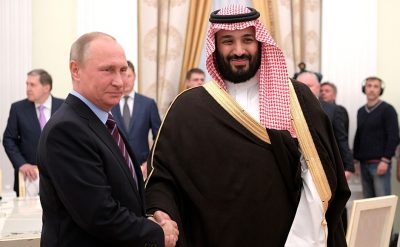
Putin and Saudi Crown Prince Mohammed bin Salman want is for US
producers to share the pain of oil production cuts in order to stabilize
prices. It’s an entirely reasonable request. Here’s a clip
from an article at oilprice.com that helps to explain what’s really
going on:
“… there was a sliver of hope that oil prices may rebound after Reuters reported that Saudi Arabia, Russia and allied oil producers will agree to deep cuts to their crude output at talks this week but only if the United States and several others join in with curbs to help prop up prices that have been hammered by the coronavirus crisis. However, in an attempt to have its cake and eat it too, the U.S. DOE said on Tuesday that U.S. output is already falling without government action, in line with the White House’s insistence that it would not intervene in the private markets….… OPEC+ will require the United States to make cuts in order to come to an agreement: The EIA report today demonstrates that there are already projected cuts of 2 (million bpd), without any intervention from the federal government,” the U.S. Energy Department said.That is not enough for OPEC+ however, and certainly not Russia, which on Wednesday made clear that market-driven declines in oil production shouldn’t be considered as cuts intended to stabilize the market, Kremlin spokesman Dmitry Peskov tells reporters on conference call.“These are completely different cuts. You are comparing the overall demand drop with cuts to stabilize global markets. It’s like comparing length and width,” Peskov said…..Moscow’s participation is highly contingent on the US, and is unlikely to agree to output cuts if the US does not join the effort.” (“Historic Oil Deal On The Verge Of Collapse As Russia Balks At U.S. ‘Cuts’”, oilprice.com)
Putin is being
reasonable and fair. If everyone else is forced to cut supply, then US
oil producers should have to cut supply too. But they don’t want to
share the pain, so they’ve settled on a strategy for weaseling out of
it. They want their reductions in output (from weak demand during the
pandemic) to count as “production cuts”. They even have a name for this
swindle, they call it “organic production cuts”, which means no cuts at
all. This is the way hucksters do business not responsible adults.
What does Putin want from this deal?
Price stability.
Yes, he’d like to see prices settle somewhere north of $45 per barrel
but that’s not going to happen for a while. The combination of a weaker
demand (due to the coronavirus) and oversupply (from the Saudis flooding
the market) have ensured that prices will remain low for the
foreseeable future. Even so, Putin understood what the Saudis were doing
by flooding the market, and he knew it wasn’t directed at Russia. The Saudis were trying to persuade US oil producers to stop freeloading and cut production like everyone else. That’s the long and short of it. Check out this excerpt from an article by oil expert, Simon Watkins at oilprice.com:
“Saudi Arabia was continually peeved …(because) its efforts to keep oil prices up through various OPEC and OPEC+ agreements were allowing these very shale producers to make a lot more money than the Saudis, relatively speaking. The reason for this was that U.S. shale producers…. were not bound in to the OPEC/OPEC+ production quotas so could fill the output gaps created by OPEC producers.” (“The Sad Truth About The OPEC+ Production Cut”, Simon Watkins, oilprice.com)
This is what the
media fails to tell their readers, that US oil producers– who don’t
participate in any collective effort to stabilize prices– have been
exploiting OPEC production quotas in order to fatten the bottom line at
the expense of others. US producers figured out how to game the system and make a bundle in the process. Is it any wonder why the Saudis were pissed?? Here’s more from the same article:
“This allowed the U.S. a rolling 3-4 million bpd advantage over Saudi in the oil exports game, meaning that it quickly became the world’s number one oil producer…. Hence, Saudi Arabia decided initially to unilaterally announce its intention for the last OPEC+ deal to be much bigger than that which it had pre-agreed with Russia, hoping to ambush the Russians into agreeing. Russia, however, turned around and told Saudi Arabia to figuratively go and reproduce with itself. MbS,… then decided to launch an all-out price war.” (oilprice.com)
So you can see
that this really had nothing to do with Russian at all. The Crown Prince
was simply frustrated at the way US oil producers were gaming the
system, which is why he felt like he had to respond by flooding the
market. The obvious target was the US shale oil industry that
was taking advantage of the quotas, refusing to cooperate with fellow
oil producers and generally freeloading off the existing quota system.
And what’s
funny, is that as soon as the Saudis started putting the screws to the
US fracking gang, they all scampered off to Washington en masse to beg
for help from Papa Trump. Which is why Trump decided to make emergency
calls to Moscow and Riyadh to see if he could hash out a deal.
It’s worth
noting that domestic oil producers have been involved in other dodgy
activities in the past. Check out this excerpt from an article in the
Guardian in 2014, the last time oil prices crashed:
“After standing at well over $110 a barrel in the summer, the cost of crude has collapsed. Prices are down by a quarter in the past three months….Think about how the Obama administration sees the state of the world. It wants Tehran to come to heel over its nuclear programme. It wants Vladimir Putin to back off in eastern Ukraine. But after recent experiences in Iraq and Afghanistan, the White House has no desire to put American boots on the ground. Instead, with the help of its Saudi ally, Washington is trying to drive down the oil price by flooding an already weak market with crude. As the Russians and the Iranians are heavily dependent on oil exports, the assumption is that they will become easier to deal with…The Saudis did something similar in the mid-1980s. Then, the geopolitical motivation for a move that sent the oil price to below $10 a barrel was to destabilize Saddam Hussein’s regime….Washington’s willingness to play the oil card stems from the belief that domestic supplies of energy from fracking make it possible for the US to become the world’s biggest oil producer. In a speech last year, Tom Donilon, then Barack Obama’s national security adviser, said the US was now less vulnerable to global oil shocks. The cushion provided by shale oil and gas “affords us a stronger hand in pursuing and implementing our national security goals”. (“Stakes are high as US plays the oil card against Iran and Russia”, The Guardian)
This excerpt
shows that Washington is more than willing to use the “oil card” if it
helps to achieve its geopolitical objectives. Not surprisingly, good
buddy, Saudi Arabia, has historically played a key role in helping to
promote those goals. The current incident, however, is the exact
opposite. The Saudis aren’t helping the US achieve its objectives, quite
the contrary, they’re lashing out in frustration. They feel like
they’re being squeezed by Washington (and US producers) and they want to
prove that they have the means to fight back. Flooding the market was
just MBS’s way of “letting off steam”.
Trump
understands this, but he also understands who ultimately calls the
shots, which is why he took the unusual step of explicitly warning the
Saudis that they’d better shape up and step in line or there’d be hell
to pay. Here’s a little background that will help to connect the dots:
“..the deal made in 1945 between the U.S. President Franklin D. Roosevelt and the Saudi King at the time, Abdulaziz, that has defined the relationship between the two countries ever since… the deal that was struck between the two men on board the U.S. Navy cruiser Quincy… was that the U.S. would receive all of the oil supplies it needed for as long as Saudi Arabia had oil in place, in return for which the U.S. would guarantee the security of the ruling House of Saud. The deal has altered slightly ever since the rise of the U.S. shale oil industry and Saudi Arabia’s attempt to destroy it from 2014 to 2016, in that the U.S. still guarantees the security of the House of Saud but it also expects Saudi Arabia not only to supply the U.S. with whatever oil it needs for as long as it can but also – and this is key to everything that has followed – it also allows the U.S. shale industry to continue to function and to grow.As far as the U.S. is concerned, if t his means that the Saudis lose out to U.S. shale producers by keeping oil prices up but losing out on export opportunities to these U.S. firms then tough..As U.S. President Donald Trump has made clear whenever he has sensed a lack of understanding on the part of Saudi Arabia for the huge benefit that the U.S. is doing the ruling family: “He [Saudi King Salman] would not last in power for two weeks without the backing of the U.S. military.” (“The Sad Truth About The OPEC+ Production Cut”, Simon Watkins, Oil Price)
Trump felt like
he had to remind the Saudis how the system actually works: Washington
gives the orders and the Saudi’s obey. Simple, right? In fact, the Crown
Prince has already slashed oil production dramatically and is fully
complying with Trump’s directives, because he knows if he doesn’t, he’s
going to wind up like Saddam Hussein or Muammar Gaddafi.
Meanwhile, US
shale oil producers won’t be required to make any cuts at all or, as the
New York Times puts it: “It was not immediately clear if the Trump
administration made a formal commitment to cut production in the United
States.”
Got that? So
everyone else cuts production, everyone else sees their revenues shrink,
and everyone else pitches-in to put a floor under prices. Everyone
except the “exceptional” American oil producers from the exceptional
United States. They don’t have to do a damn thing.
*
Note to readers: please click the share
buttons above or below. Forward this article to your email lists.
Crosspost on your blog site, internet forums. etc.
This article was originally published on The Unz Review.
The original source of this article is Global Research
Copyright © Mike Whitney, Global Research, 2020
Comment on Global Research Articles on our Facebook page
Become a Member of Global Research

