
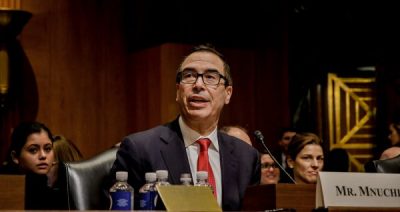
The spin is in! Trump administration economic ‘message bearers’, Steve Mnuchin, US Treasury Secretary, and Kevin Hasset,
senior economic adviser to Trump, this past Sunday on the Washington TV
talking heads circuit launched a coordinated effort to calm the growing
public concern that the current economic contraction may be as bad (or
worse) than the great depression of the 1930s.
Various big
bank research departments predicting a GDP contraction in the first
quarter (January-March 2020) anywhere from -4% to -7.5%, and for the
current second quarter, a further contraction from -30% to -40%: Morgan
Stanley investment bank says 30%. The bond market investment behemoth,
PIMCO, estimates a 30% fall in GDP. Even Congress’s Budget Office
recently estimate the contraction in GDP could be as high as -40% in the
2nd quarter.
Mnuchin-Hassett’s New Old Normal
Despite the
flashing red lights on the state of the US economy, the Trump
administration’s key economic spokespersons are pushing the official
line that the economy will soon quickly ‘snap back’. On the near horizon
is a V-shape recovery coming in the 3rd quarter (July-September) or, at the latest, the following 4th
quarter. The economy may be particularly bad, they admit, but be
patient folks a return to normal is on the way before year end!
Speaking on
Fox News Sunday Treasury Secretary, Mnuchin, declared the US economy is
about to open up in May and June and “you’re going to see the economy
really bounce back in July, August and September”. And Hassett echoed
the same, just a barely less optimistic viewing the snap back in the 4th quarter. Getting ahead of the bad news coming this Wednesday when 1st
quarter US GDP numbers are due for release, Hassett admitted a big
shock is coming on Wednesday, to be followed by “A few months of
negative news that’s unlike anything you’ve ever seen”. But not to
worry, according to Hassett, the 4th quarter “Is going to be really strong and next year is going to be a tremendous year”.
Meanwhile, the
administration’s big banker allies were also making their TV news show
rounds, singing the same ‘happy days will soon be here again’ tune. Bank
of America’s CEO, Moynihan, appearing on ‘Face the Nation’ show,
predicted consumer spending had bottomed out and would soon rise nicely
again in the 4th quarter, October-December, followed by double digit GDP growth in 2021!
The Trump
administration is pressing hard to reopen the economy now! It knows if
it doesn’t the contraction of the economy could settle in to a medium to
long term stagnation and decline. Business interests are pushing Trump
and Republicans to reopen quickly, regardless of the likely
consequences for a second wave of the virus devastating national health
and death rates. There is a growing segment of US business interests
desperate to see a return to sales and revenue, without which they face
imminent defaults and bankruptcies after a decade of binging on
corporate debt. A growing wave of defaults and bankruptcies could very
well provoke an eventual financial crisis which would exacerbate the
collapse of the real economy even further.
The Fed’s $9 Trillion May Not Succeed
So far the
Federal Reserve central bank has committed to $9 trillion in loans and
financial backstopping to the banks and non-banks, in an unprecedented
historic experiment by the Fed. Not just the magnitude of the Fed
bailout in dollar terms, already twice that the central bank employed in
2008-09 to bail out the banks in that prior crash, but the Fed this
time is not waiting for the banks to fail. It’s pre-emptively bailing
them out! Also new is the Fed is bailing out non-banks as well, trying
to delay the defaults and bankruptcies at their origin, before the
effects began hitting the banking system. Bailing out non-banks is new
for the Fed as well, no less than the pre-emptive bank rescue and the $9
trillion—and rising—total free money being thrown at the system. But
it should not be assumed the Fed will succeed, despite its blank check
to banks and businesses. Its historic, unprecedented experiment is not
foreordained to succeed—for reasons explained below.
For the
magnitude and rapidity of the shutdown of the real economy in the US is
no less unprecedented. Even during the great depression of the 1930s,
the contraction of the real economy occurred over a period of several
years—not months. It wasn’t until 1932-33 that unemployment had reached
25%.
As of late
April 2020, that 25% unemployment rate was already a fact. The official
government data indicated 26.5m workers had filed for unemployment
benefits. That’s about 16.5% of the 165 million US civilian labor
force. Bank forecasts are 40 million jobless on benefits by the end of
May. But respected research sources, like the Economic Policy Institute,
recently estimated that as many as 13.9m more are actually out of work
but have not yet been able to successfully file for unemployment
benefits. So the 40 million jobless may already be here. And that’s
roughly equivalent to a 25% unemployment rate. In other words, in just a
couple months the US economy has collapsed to such an extent that the
jobless ranks are at a level that took four years to attain during the
great depression of the 1930s!
A contraction
that fast and that deep likely has dynamics to it that are unknown. It
may not respond to normal policy like enhanced unemployment benefits,
emergency income checks, and even grants and loans to businesses on an
unprecedented scale such as being provided by the Fed. The psychology
of consumers, workers, businesses, and certainly investors may be so
shocked and wounded that the money injections—by Congress and by the
Fed—may not quickly result in a return to spending and production. The
uncertainty of what the future may bring may be creating an equally
unprecedented fear of spending the money. Economists sometimes call this
a ‘liquidity trap’. But it may more accurately be called a ‘liquidity
chasm’ out of which the climb back will prove very slow, very
protracted, and the road strewn with economic landmines that could set
the economy on a second or third collapse along the way.
Image on the right: Kevin Hasset (Source: Wikimedia Commons)

The V-shape
argument is predicated on the assumption that the virus’s negative
effect will dissipate this summer. Those supporting the argument assume,
openly or indirectly, that the economic collapse today is largely, if
not totally, due to the virus. It’s not really an economic crisis; it’s a
health crisis. And when the latter is resolved, the economic crisis
will fade as well as a consequence.
But this
assumes two things: first that the virus will in fact ‘go away’ soon and
not hang like a dead weight on the economy. Second, that there were not
underlying economic causes that were slowing the US (and global)
economy already before the virus’s impact. The virus is seen as the sole
cause, in other words, and not as a precipitating factor that
accelerated an already weak and fragile economy into a deep
contraction. But the virus may be best understood as an event that
precipitated and then accelerated the contraction of an economy already
headed for a slowdown and recession.
These latter
possible ways to understand the current economic crisis are of course
ignored by the advocates of a V-shape recovery. In their view, it’s just
a health crisis. And the health crisis is about to end soon. And when
it does, we’ll return to the old ‘normal’ and the economy will snap
back. But the depth and rapidity of the decline into what is, at least, a
‘great recession 2.0’ and perhaps something more like the even deeper
and longer great depression of the 1930s, strongly suggests that forces
of decline have been unleashed in the US economy that have a dynamic of
their own now. And that dynamic is independent of the precipitating
cause of the virus which, in any event, is not going away soon either.
In all cases of such virus contagion, there has always been a second and
even third wave of infection and death. And Covid-19 appears the most
aggressive and contagious.
It’s not just the 40 million and likely more unemployed that define the unprecedented severity of the current crisis.
Millions of
small businesses have already shut down or gone out of business. More
will soon follow. And many will never re-open again. The average number
of days of cash on hand for small businesses before the virus impact was
27 days. Many small businesses are projected to run out of that by end
of April. That’s why we are not witnessing growing protests and refusals
to abide by a ‘sheltering in place’ order announced by various state
governors. Small businesses and their workers, both on the brink of
bankruptcy are taking to the streets—encouraged of course by radical
right forces, conservative business interests, and political allies
right up to the White House.
The millions
of workers who haven’t been able to get through to successfully file and
obtain unemployment benefits, and the millions of smallest businesses
who have been squeezed out of the Small Business bailout program (called
the Pay Protection Program) are fertile ground for right wing
propaganda demanding the country reopen the economy immediately, even if
it’s premature in terms of suspending virus mitigation efforts and
almost sure to result in a second wave of infection that will debilitate
the economy again later in the year.
And the flow
of funding from recent small business legislation passed by Congress has
been bottled up by big banks gaming the system—first using the crisis
to extract concessions from the federal government on further bank
deregulation, getting guarantees by the government on liability
protection, ensuring they receive lucrative fees and charges from the
lending, and requiring the government to reimburse them for loans that
might later default and fail.
In addition to
the slow distribution of the loans by the big banks, the same big banks
began re-directing the small business program loan funds first to their
own largest and best customers. Thus the first $350 billion in Congress
funding for small business was directed to the banks’ best customers in
less than two weeks. A second $320 billion supplement just added is
reportedly already accounted for in less than half that time.
Despite the
data on jobs, small business, and GDP much of the liberal economist
establishment appear to be falling for the Trump administration official
line and spin that there’ll soon be a V-shape recovery.
Liberal Economists Buy the Mnuchin-Hassett Line
The dean of
liberal economists, Paul Krugman, in one of his columns recently, says
it’s not an economic crisis but a disaster relief situation. Kind of
like an economic hurricane, he added, that once it passes the sun will
come out and shine again at the same economic intensity as before. And
then there’s Larry Summers, Harvard economics professor and advisor to
Barack Obama in 2009, who agreed with Krugman, saying “it’s possible to
collapse and come back quite quickly.” Or Robert Reich, Cal Berkeley
professor and former member of Bill Clinton’s cabinet, who declared in
another TV interview recently, that the crisis wasn’t economic but a
health crisis and as soon as the health problem was contained
(presumably this summer) the economy would ‘snap back’.
Theirs is
economic analysis by means of weather metaphors. And the error they all
make is assuming that the fundamental cause of the crisis is not
economic but the virus. They don’t see the virus as only a precipitating
cause, exacerbating and accelerating what was a basically weak US and
global economy going into the crisis, but instead the virus is the sole,
fundamental cause of the deep contraction.
Krugman and
other proponents of the ‘snap back’ (V-shape recovery) thesis all deny
the counter argument that the current deep and rapid economic decline is
precipitated by the crisis and that there is an internal economic
dynamic set in motion that is taking over that driving the economy into a
downward spiral regardless of the initial health crisis effect.
As one partial
example of that internal dynamic: once the contraction in the real
economy accelerates and deepens, it inevitably leads to defaults and
bankruptcies—among businesses, households, and even local governments.
The defaults and bankruptcies then provoke a financial crisis that feeds
back on the real economy, causing it to deteriorate still further.
Income losses by businesses, households and local government thereafter
in turn cause a further decline. Once negative mutual feedback effects
within the economy begin, it matters little if the health crisis is soon
abated. The economic dynamic has been set in motion. Krugman and
friends should understand that but either don’t, or are cautioned by
their employers and political friends not to tell the whole truth lest
it cause further concern, lack of business and consumer confidence, or
even panic.
When
mainstream economists don’t understand what’s actually happening, they
hide behind their metaphors as a way to obfuscate their lack of
understanding and ability to forecast the future. Or they employ the
same metaphors to avoid telling the truth. But the truth is this isn’t
just a health crisis. And it won’t quickly disappear even if the health
issue were resolved in a matter of weeks or months.
Instead of
pacifying the public with nice metaphors, they might just look at the
recent past. No snap back economic recovery occurred after 2008-09,
which was a contraction far weaker in relative terms than the present,
with fewer job losses and a much smaller GDP decline.
2008-09 Recovery Was No V-Shape
Even after the
less severe 2008-09 contraction, bank lending after 2009 did not return
immediately or even normally. Only the largest, best customers of the
big banks and their offshore clients received new loans from them. Bank
lending to US small and medium businesses continued to decline for
years after 2009. And jobs lost in 2008-09 did not recover to the levels
of 2007 just before the recession began until 2015. Wages of jobs
recovered from 2008 to 2015 was much lower compared to wages of 2007
jobs that were lost. The ratio between full time jobs and part
time/temp/contract work deteriorated after 2009, with more of the latter
hired and the former not rehired. Real wages still has not recovered
to this day for tens of millions of workers at median income levels and
below.
So one can
only wonder what the Krugmans, Summers and Reichs are ‘smoking’ when
they make ridiculous declarations about ‘snap back’ recovery. They
should know better. All they had to do was look at the evidence of the
historical record post-2009 that V-shape recoveries do not happen when
there are deep and rapid contractions! And that’s true not only for
2009, but even for 1933 when the great depression finally bottomed out.
Between 1929
and 1933 the US economy continued to contract. Not all at once, but in a
kind of ‘ratcheting down’ series of lower plateaus as banking crises
erupted in 1930, 1931, 1932 and then again in early 1933. When Roosevelt
came into office in March 1933 he introduced a program aimed at bailing
out the banks first, and then assisting business to raise prices. It
was called the National Recovery Act. That program stopped the collapse
but generated only modest recovery, and by mid-1934 that recovery had
dissipated. It was then, in the fall of 1934, that Roosevelt and the
Democrats proposed what would be called the New Deal, which was launched
in 1935 after the mid-term 1934 Congressional elections. The US economy
began to recovery rapidly in 1935 to 1937. In late 1937 Republicans
and conservative Democrats in the South allied together and cut back New
Deal social spending. The US economy relapsed back into depression in
1938 until Congress, fearful of the return to Depression, reinstated New
Deal spending and the economy recovered again to where it was in 1937.
The permanent recovery did not begin until 1940-41, as the US economy
mobilized for war and government spending rose from 15%-17% of GDP to
more than 40% in one year in 1942.
But mainstream
economists are not very attentive to their own country’s economic
history. If they were they would understand that deep and rapid economic
contractions always result in slow, protracted, and often uneven
recoveries. There never is a ‘snap back’ when depression levels of
contraction occur—or even when ‘great recession’ levels occur, as in
2008-09. It takes a long time for both business and consumers to restore
their ‘confidence’ levels in the economy and change ultra-cautious
investing and purchasing behavior to more optimistic spending-investing
patterns. Unemployment levels hang high and over the economy for some
time. Many small businesses never re-open and when they do with fewer
employees and often at lower wages. Larger companies hoard their cash.
Banks typically are very slow to lend with their own money. Other
businesses are reluctant to invest and expand, and thus rehire, given
the cautious consumer spending, business hoarding, and banks’
conservative lending behavior. The Fed, the central bank, can make a
mass of free money and cheap loans available, but businesses and
households may be reluctant to borrow, preferring to hoard their
cash—and the loans as well.
In other
words, the deeper and faster the contraction, the more difficult and
slower the recovery. That means the recovery is never a V-shape, but
more like an extended U-shape.
*
Note to readers: please click the share
buttons above or below. Forward this article to your email lists.
Crosspost on your blog site, internet forums. etc.
Dr. Rasmus
is author of the just released book, The Scourge of Neoliberalism: US
Economic Policy from Reagan to Trump’, Clarity Press, January 2020; and
the preceding book, ‘Central Bankers at the End of Their Ropes: Monetary
Policy and the Coming Depression’, Clarity Press, August 2017. He blogs
at jackrasmus.com. His twitter handle is @drjackrasmus and his website:
http://kyklosproductions.com. He is a frequent contributor to Global Research.
Featured image is from Shutterstock
The original source of this article is Global Research
Copyright © Dr. Jack Rasmus, Global Research, 2020

