Cervantes

Hoy es el día más hermoso de nuestra vida, querido Sancho; los obstáculos más grandes, nuestras propias indecisiones; nuestro enemigo más fuerte, el miedo al poderoso y a nosotros mismos; la cosa más fácil, equivocarnos; la más destructiva, la mentira y el egoísmo; la peor derrota, el desaliento; los defectos más peligrosos, la soberbia y el rencor; las sensaciones más gratas, la buena conciencia, el esfuerzo para ser mejores sin ser perfectos, y sobretodo, la disposición para hacer el bien y combatir la injusticia dondequiera que esté.

MIGUEL DE CERVANTES
Don Quijote de la Mancha.
La Colmena no se hace responsable ni se solidariza con las opiniones o conceptos emitidos por los autores de los artículos.

21 de mayo de 2022

The History and Geopolitics of U.S. Expansionism in the Heart of Eurasia


Global Research, May 19, 2022
In 1994 the United States Department of Energy (DOE) calculated that there are colossal oil and natural gas reserves in the Caspian region. The Caspian Sea, the world’s largest inland body of water, is bordered by Russia and Iran along with the former Soviet republics of Kazakhstan, Turkmenistan and Azerbaijan.

It was expected in Washington that the Caspian’s fossil fuel sources would reduce US dependence on the Middle East, an area which Western elites have traditionally been fixated on, because of its unparalleled oil and gas deposits; but a region which had become volatile and unstable this century, largely as a result of the US-led wars in the Middle East.

Ensuring control of the Caspian area would further assist Washington, by allowing the US government to diversify sources of import and give it more options and control. Such goals guided Washington in expanding its influence over Central Asia, which is situated not far from the Caspian Sea. Central Asia spans about 1.5 million square miles and comprises of Kazakhstan, Kyrgyzstan, Tajikistan, Turkmenistan and Uzbekistan. These countries contain significant natural resources and are surrounded by Russia, China, South Asia and the Middle East.

The Soviet Union’s collapse, in 1991, enabled Washington to proceed with its aim of extending US hegemony, by penetrating into the heart of Eurasia. In doing so, the Americans hoped their imperialist policies would leave Russia and Iran in a weakened condition. Yet Russia, Iran and the Central Asian states combined contain 15% or more of global oil reserves, and as much as 50% of all known gas sources.
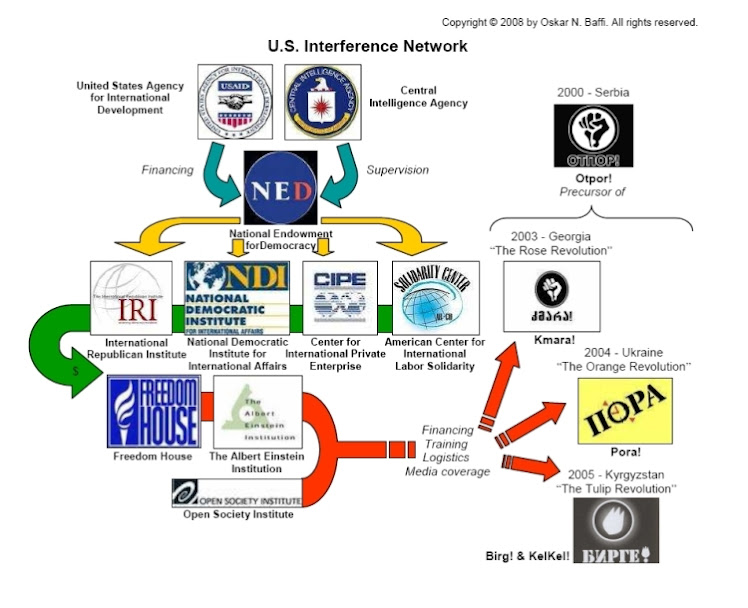
In the 1990s especially, the Americans under president Bill Clinton were acting internationally as the single hegemonic superpower, the centre of world influence; dictating its virulent neoliberal brand of capitalism as the path to “economic development”. A chief geopolitical priority of the US in the post-Soviet era, was to lure the Central Asia/Caucasus space under NATO’s umbrella, through military involvement and regime change; installing or supporting regimes that would acquiesce to the free-market economy; open trade to American and European investment, while allowing the West supremacy over Eurasia’s mineral deposits.

The US through military and economic persuasion particularly targeted Kazakhstan, Uzbekistan, Tajikistan and Turkmenistan, countries which had seceded from the Soviet Union. These states had yet to be integrated into the American-led globalist system. They were once among the least affluent of the Soviet republics. Regardless, they boast impressive quantities of crude oil, and together hold an equal or greater amount of petroleum than Saudi Arabia, which contains the world’s 2nd largest oil reserves.

With Azerbaijan, 3 out of the 5 Central Asian countries combined (Turkmenistan, Uzbekistan and Kazakhstan) possess among the richest natural gas reserves found anywhere. Kazakhstan has the 2nd largest oil reserves among the countries of the former Soviet Union, and the 12th biggest on earth. Kazakhstan further contains considerable quantities of gas and its hydrocarbon reserves (oil and gas) are valued at $8.7 trillion.

The Energy Task Force headed by Dick Cheney, George W. Bush’s vice-president from 2001 to 2009, calculated that the proven oil sources in Kazakhstan and Uzbekistan, along with sectors of the Caspian Sea, amounts to 20 billion barrels. This equates to more petroleum than is present in the North Sea.

The entire oil reserves of the Central Asian/Caspian regions could total more than 60 billion barrels, and even reach as high as 200 billion barrels of oil, according to John J. Maresca, an ex-US government official with connections to the fossil fuel industry. Western energy corporations were lining up. They had the means to increase petroleum production in the centre of Eurasia by over 500% – from a modest 870,000 barrels in 1995 to 4.5 million by 2010, the equivalent of 5% of global crude oil manufacturing. [...]

Alerta Venezuela

No dejen de ver este conmovedor video

LatinoAmérica Calle 13

The American Dream

Facebook, Israel y la CIA


La Revolucion de la Clase Media


Descontento en el corazon del capitalismo: el Reino Unido

Descontento en el corazon del capitalismo: el Reino Unido

La Ola se extiende por todo el mundo arabe : Bahrein

La Caida de un Mercenario

La Revolucion no sera transmitida (I)

(II) La revolucion so sera transmitida

(III) La Revolucion no sera transmitida

(IV) La Revolucion no sera transmitida

(V) La Revolucion no sera transmitida

(VI) La Revolucion no sera transmitida

(VII) La revolucion no sera transmitida

(VIII) La Revolucion no sera transmitida

Narcotrafico SA

La otra cara del capitalismo...

Manuel Rosales mantenia a la oposicion con el presupuesto de la Gobernacion del Zulia...

El petroleo como arma segun Soros

Lastima que se agacho...

El terrorismo del imperio

Promocional DMG

Uribe y DMG