It was good to hear that voice again. A voice of provoking interest that pitter patters, feline across a parquet, followed by the usual devastating conclusion. Julian Assange’s last public address was made in the Ecuadorian Embassy in London. There, he was a guest vulnerable to the capricious wishes of changing governments. At Belmarsh Prison in London, he was rendered silent, his views conveyed through visitors, legal emissaries and his family.
The hearing in Strasbourg on October 1, organised by the Committee on Legal Affairs and Human Rights of the Parliamentary Assembly of the Council of Europe (PACE), arose from concerns raised in a report by Iceland’s Thórhildur Sunna Ævarsdóttir, in which she expressed the view that Assange’s case was “a classic example of ‘shooting the messenger’.” She found it “appalling that Mr Assange’s prosecution was portrayed as if it was supposed to bring justice to some unnamed victims the existence of whom has never been proven, whereas perpetrators of torture or arbitrary detention enjoy absolute impunity.”
His prosecution, Ævarsdóttir went onto explain, had been designed to obscure and deflect the revelations found in WikiLeaks’ disclosures, among them abundant evidence of war crimes committed by US and coalition forces in Iraq and Afghanistan, instances of torture and arbitrary detention in the infamous Guantánamo Bay camp facility, illegal rendition programs implicating member states of the Council of Europe and unlawful mass surveillance, among others.
A draft resolution was accordingly formulated, expressing, among other things, alarm at Assange’s treatment and disproportionate punishment “for engaging in activities that journalists perform on a daily basis” which made him, effectively, a political prisoner; the importance of holding state security and intelligence services accountable; the need to “urgently reform the 1917 Espionage Act” to include conditional maliciousness to cause harm to the security of the US or aid a foreign power and exclude its application to publishers, journalists and whistleblowers.
Assange’s full testimony began with reflection and foreboding: the stripping away of his self in incarceration, the search, as yet, for words to convey that experience, and the fate of various prisoners who died through hanging, murder and medical neglect. While filled with gratitude by the efforts made by PACE and the Legal Affairs and Human Rights Committee, not to mention innumerable parliamentarians, presidents, prime ministers, even the Pope, none of their interventions “should have been necessary.” But they proved invaluable, as “the legal protections that did exist, many existed only on paper or were not effective in any remotely reasonable time frame.”
The legal system facing Assange was described as encouraging an “unrealisable justice”. Choosing freedom instead of purgatorial process, he could not seek it, the plea deal with the US government effectively barring his filing of a case at the European Court of Human Rights or a freedom of information request. “I am not free today because the system worked,” he insisted. “I am free today because after years of incarceration because I plead guilty to journalism. I plead guilty to seeking information from a source. I plead guilty to informing the public what that information was. I did not plead guilty to anything else.”
When founded, WikiLeaks was intended to enlighten people about the workings of the world. “Having a map of where we are lets us understand where we might go.” Power can be held to account by those informed, justice sought where there is none. The organisation did not just expose assassinations, torture, rendition and mass surveillance, but “the policies, the agreements and the structures behind them.”
Since leaving Belmarsh prison, Assange rued the abstracting of truth. It seemed “less discernible”. Much ground had been “lost” in the interim; truth had been battered, “undermined, attacked, weakened and diminished. I see more impunity, more secrecy, more retaliation for telling the truth and more self-censorship.”
Much of the critique offered by Assange focused on the source of power behind any legal actions. Laws, in themselves, “are just pieces of paper and they can be reinterpreted for political expedience”. The ruling class dictates them and reinterprets or changes them depending on circumstances.
In his case, the security state “was powerful enough to push for a reinterpretation of the US constitution,” thereby denuding the expansive, “black and white” effect of the First Amendment. Mike Pompeo, when director of the Central Intelligence Agency, simply lent on Attorney General William Barr, himself a former CIA officer, to seek the publisher’s extradition and re-arrest of Chelsea Manning. Along the way, Pompeo directed the agency to draw up plans of abduction and assassination while targeting Assange’s European colleagues and his family.
The US Department of Justice, Assange could only reflect, cared little for the moderating tonic of legalities – that was something to be postponed to a later date. “In the meantime, the deterrent effect that it seeks, the retributive actions that it seeks, have had their effect.” A “dangerous new global legal position” had been established as a result: “Only US citizens have free speech rights. Europeans and other nationalities do not have free speech rights.”
PACE had, before it, an opportunity to set norms, that “the freedom to speak and the freedom to publish the truth are not privileges enjoyed by a few but rights guaranteed to all”. “The criminalisation of newsgathering activities is a threat to investigative journalism everywhere. I was formally convicted, by a foreign power, for asking for, receiving, and publishing truthful information about that power while I was in Europe.”
A spectator, reader or listener might leave such an address deflated. But it is fitting that a man subjected to the labyrinthine, life-draining nature of several legal systems should be the one to exhort to a commitment: that all do their part to keep the light bright, “that the pursuit of truth will live on, and the voices of the many are not silenced by the interests of the few.”
*
Click the share button below to email/forward this article to your friends and colleagues. Follow us on Instagram and Twitter and subscribe to our Telegram Channel. Feel free to repost and share widely Global Research articles.
Get Your Free Copy of “Towards a World War III Scenario: The Dangers of Nuclear War”!
Dr. Binoy Kampmark was a Commonwealth Scholar at Selwyn College, Cambridge. He currently lectures at RMIT University. He is a Research Associate of the Centre for Research on Globalization (CRG). Email: bkampmark@gmail.com
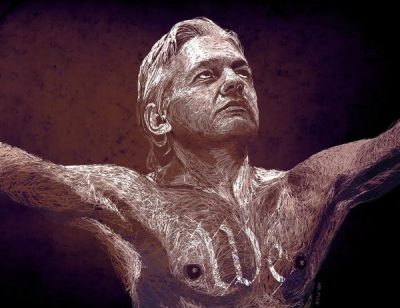
Featured image: The Crucifixion of Julian Assange – by Mr. Fish