“La sabiduría de la vida consiste en la eliminación de lo no esencial. En reducir los problemas de la filosofía a unos pocos solamente: el goce del hogar, de la vida, de la naturaleza, de la cultura”.
Lin Yutang
Cervantes
Hoy es el día más hermoso de nuestra vida, querido Sancho; los obstáculos más grandes, nuestras propias indecisiones; nuestro enemigo más fuerte, el miedo al poderoso y a nosotros mismos; la cosa más fácil, equivocarnos; la más destructiva, la mentira y el egoísmo; la peor derrota, el desaliento; los defectos más peligrosos, la soberbia y el rencor; las sensaciones más gratas, la buena conciencia, el esfuerzo para ser mejores sin ser perfectos, y sobretodo, la disposición para hacer el bien y combatir la injusticia dondequiera que esté.
MIGUEL DE CERVANTES Don Quijote de la Mancha.
La Colmena no se hace responsable ni se solidariza con las opiniones o conceptos emitidos por los autores de los artículos.
This article was originally published at The Conversation. The publication contributed the article to Space.com's Expert Voices: Op-Ed & Insights. Toby Brown, Postdoctoral Fellow in Astrophysics, McMaster University Curious Kids is a series for children of all ages. Have a question you’d like an expert to answer? Send it to CuriousKidsCanada@theconversation.com.
The
origin of the moon’s name is a very interesting story. Humans have been
aware of this great white orb in the sky ever since they first roamed
the Earth.
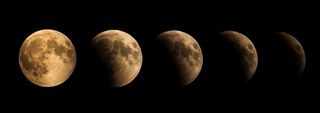
The moon’s appearance changes as the months pass. It moves through phases from full moon to new moon, and back again.
The
Earth has just one moon. It is best known as the moon in the
English-speaking world because people in ancient times used the moon to
measure the passing of the months. The word moon can be traced to the word mōna, an Old English word from medieval times. Mōna shares its origins with the Latin words metri, which means to measure, and mensis, which means month.
So, we see that the moon is called the moon because it is used to measure the months.
Galileo’s discovery
So, why do the moons around other planets have names, while ours is just the moon?
When
the moon was named, people only knew about our moon. That all changed
in 1610 when an Italian astronomer called Galileo Galilei discovered
what we now know are the four largest moons of Jupiter.
A
statue of Galileo Galilei in Florence, Italy. He was a 16th century
Italian scientists who is known as the father of modern astronomy. (Image credit: Shutterstock)Other
astronomers across Europe discovered five moons around Saturn during
the 1600s. These objects became known as moons because they were close
to their planets, just as our own moon is close to the Earth.
It’s fair to say that other moons are named after our own moon.
The
newly discovered moons were each given beautiful names to identify them
among the growing number of planets and moons astronomers were finding
in the solar system.
Many of these names came from Greek myths.
The four large moons Galilei discovered around Jupiter were named Io,
Europa, Ganymede and Callisto.
Astronomers continue to find new moons orbiting planets in our solar system. In October 2019, they announced they had newly discovered 20 moons around Saturn.
Hello, curious kids! Do you have a question you’d like an expert to answer? Ask an adult to send your question to CuriousKidsCanada@theconversation.com. Please tell us your name, age and the city where you live. And
since curiosity has no age limit — adults, let us know what you’re
wondering, too. We won’t be able to answer every question, but we will
do our best.
[Deep knowledge, daily.Sign up for The Conversation’s newsletter.] This article is republished from The Conversation under a Creative Commons license. Read the original article. Follow all of the Expert Voices issues and debates — and become part of the discussion — on Facebook and Twitter. The views expressed are those of the author and do not necessarily reflect the views of the publisher.
Join our Space Forums to
keep talking space on the latest missions, night sky and more! And if
you have a news tip, correction or comment, let us know at: community@space.com.