“La sabiduría de la vida consiste en la eliminación de lo no esencial. En reducir los problemas de la filosofía a unos pocos solamente: el goce del hogar, de la vida, de la naturaleza, de la cultura”.
Lin Yutang
Cervantes
Hoy es el día más hermoso de nuestra vida, querido Sancho; los obstáculos más grandes, nuestras propias indecisiones; nuestro enemigo más fuerte, el miedo al poderoso y a nosotros mismos; la cosa más fácil, equivocarnos; la más destructiva, la mentira y el egoísmo; la peor derrota, el desaliento; los defectos más peligrosos, la soberbia y el rencor; las sensaciones más gratas, la buena conciencia, el esfuerzo para ser mejores sin ser perfectos, y sobretodo, la disposición para hacer el bien y combatir la injusticia dondequiera que esté.
MIGUEL DE CERVANTES Don Quijote de la Mancha.
La Colmena no se hace responsable ni se solidariza con las opiniones o conceptos emitidos por los autores de los artículos.
14 de diciembre de 2019
NASA Spacecraft Spies Huge New Storm on Jupiter After Death-Dodging Maneuver
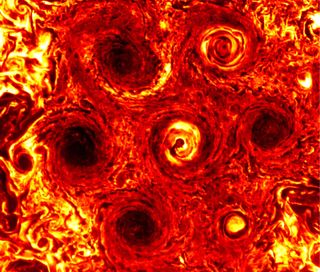
Juno has now spotted seven giant cyclones near Jupiter's south pole.
A new, smaller cyclone can be seen at the
lower right of this infrared image of Jupiter's south pole taken on Nov.
4, 2019, during the 23rd science pass of the planet by NASA's Juno
spacecraft.
SAN FRANCISCO — NASA's Juno probe
discovered a giant new storm swirling near Jupiter's south pole last
month, a few weeks after pulling off a dramatic death-dodging maneuver.
Juno spied the newfound maelstrom, which is about as wide as Texas, on Nov. 3, during its most recent close flyby of Jupiter.
The storm joins a family of six other cyclones in Jupiter's south polar
region, which Juno had spotted on previous passes by the gas giant.
(Those encounters also revealed nine cyclones near Jupiter's north pole,
by the way.)
The
southern tempests are arrayed in a strikingly regular fashion.
Previously, five of them had formed a pentagon around a central storm,
which is as wide as the continental United States. With the new
addition, that girdling structure is now a hexagon. Related: In Photos: Juno's Amazing Views of Jupiter More Photos: The Most Powerful Storms of the Solar System This
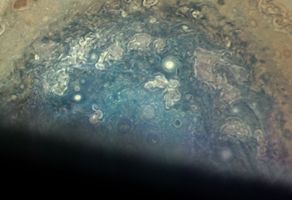
composite visible-light image taken by the JunoCam imager aboard NASA's
Juno spacecraft on Nov. 3, 2019, shows a new cyclone at Jupiter's south
pole has joined five other cyclones to create a hexagonal shape around a
large single cyclone. (Image credit: NASA/JPL-Caltech/SwRI/MSSS)"These
cyclones are new weather phenomena that have not been seen or predicted
before," Cheng Li, a Juno scientist from the University of California,
Berkeley, said in a statement yesterday (Dec. 12).
"Nature is revealing new physics regarding fluid motions and how giant planet atmospheres work," he added.
"We are beginning to grasp it through observations and computer
simulations. Future Juno flybys will help us further refine our
understanding by revealing how the cyclones evolve over time."
Juno
orbits Jupiter on a highly elliptical path every 53 Earth days,
gathering most of its data when it comes closest to the giant planet.
And those encounters are quite close indeed: During the Nov. 3 pass, the
22nd science flyby of Juno's $1.1 billion mission, the probe skimmed a
mere 2,175 miles (3,500 kilometers) above Jupiter's cloud tops, NASA
officials said.
But it took some fancy flying to make sure Juno
survived the experience. The mission team determined that the probe's
trajectory would take Juno into Jupiter's shadow for 12 hours on Nov. 3.
And that likely would've been a death sentence for the solar-powered
probe.
"We would've gotten cold. Really, really cold," Juno
project scientist Steve Levin, of NASA's Jet Propulsion Laboratory (JPL)
in Pasadena, California, said during a press conference here yesterday
at the annual fall meeting of the American Geophysical Union (AGU),
where the team announced the new results. Related: Target: Jupiter — 9 Amazing Missions to Our Largest Planet
But the navigation team at JPL came up with a solution: "jumping Jupiter's shadow."
On Sept. 30, Juno's handlers directed the solar-powered probe to fire
its small reaction-control engines in pulses for 10.5 hours. This pushed
the probe's path steadily outward — and, ultimately, out of the shadow
path altogether, Levin explained.
"Without that maneuver, without
the creative genius of the folks at JPL on the navigation team, we
wouldn't have the beautiful data that we have to show you today," he
said.
Juno launched in 2011 and arrived in orbit around Jupiter
on July 4, 2016. The spacecraft is studying Jupiter's composition and
gravitational and magnetic fields, among other things. The data Juno is
gathering should help researchers better understand how Jupiter — and,
by extension, the solar system — formed and evolved, mission team
members have said.
The initial mission plan called for Juno to
tighten its science orbit considerably, down to 14 Earth days. But the
team called off the engine burns that would have achieved this reduction
after discovering issues with the probe's fuel-delivery system. So,
Juno will stay in the 53-day orbit for the duration of its mission,
which currently goes through July 2021.
Mike Wall's book about the search for alien life, "Out There" (Grand Central Publishing, 2018; illustrated byKarl Tate), is out now. Follow him on Twitter @michaeldwall. Follow us on Twitter@Spacedotcom orFacebook.
Join our Space Forums to
keep talking space on the latest missions, night sky and more! And if
you have a news tip, correction or comment, let us know at: community@space.com.