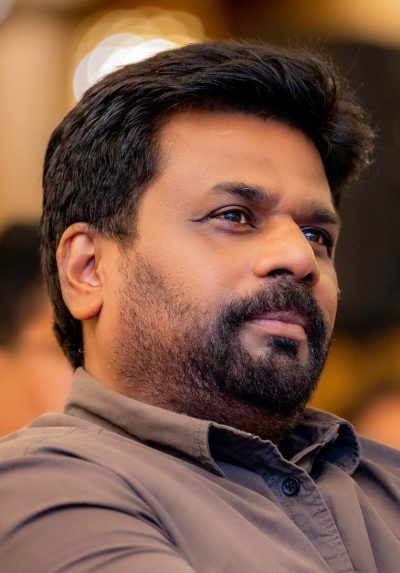
Anura Kumara Dissanayake, known with convenient laziness as AKD, became Sri Lanka’s latest president after a runoff count focusing on preferential votes. The very fact that it went to a second count with a voter turnout of 77% after a failure of any candidate to secure a majority was itself historic, the first since Sri Lankan independence in 1948.
AKD’s presidential victory tickles and excites the election watchers for various reasons. He does not hail from any of the dynastic families that have treated rule and the presidential office as electoral real estate and aristocratic privilege. The fall of the Rajapaksa family, propelled by mass protests against President Gotabaya Rajapaksa’s misrule in 2022, showed that the public had, at least for the time, tired of that tradition.
Not only is the new president outside the traditional orbit of rule and favour; he heads a political grouping known as the National People’s Power (NPP), a colourfully motley combination of trade unions, civil society members, women’s groups and students. But the throbbing core of the group is the Janatha Vimukthi Peramuna (JVP), which boasts a mere three members in the 225-member parliament.
The resume of the JVP is colourfully cluttered and, in keeping with Sri Lankan political history, spattered with its fair share of blood. It was founded in 1965 in the mould of a Marxist-Leninist party and led by Rohana Wijeweera. It mounted, without success, two insurrections – in 1971 and between 1987 and 1989. On both occasions, thousands died in the violence that followed, including Wijeweera and many party leaders, adding to the enormous toll that would follow in the civil war between the Sinhalese majority and the secessionist Liberation Tigers of Tamil Eelam.
It is also worth noting that the seduction of Marxism, just to add a level of complexity to matters, was not confined to the JVP. The Tamil resistance had itself found it appealing. A assessment from the Central Intelligence Agency from March 1986 offers the casual remark that “all major insurgent organizations claim allegiance to Marxism” with the qualification that “most active groups are motivated principally by ethnic rivalry with the majority Sinhalese.” None had a clear political program “other than gaining Columbo’s recognition for a traditional homeland and a Tamil right to self-determination.”
By the time Dissanayake was cutting his teeth in local politics, the JVP was another beast, having been reconstituted by Somawansa Amarasinghe as an organisation keen to move into the arena of ballots rather than the field of armed struggle. Dissanayake is very much a product of that change.
“We need to establish a new clean political culture … We will do the utmost to win back the people’s respect and trust in the political system.”
In a statement, Dissanayake was a picture of modest, if necessary, acknowledgment. He praised the collective effort behind his victory, one being a consequence of the multitude.
“This achievement is not the result of any single person’s work, but the collective effort of hundreds of thousands of you. Your commitment has brought us this far, and for that, I am deeply grateful. This victory belongs to all of us.”
The unavoidable issue of racial fractiousness in the country is also mentioned. “The unity of Sinhalese, Tamils, Muslims and all Sri Lankans is the bedrock of this new beginning.” How the new administration navigates such traditionally poisoned waters will be a matter of interest and challenge, not least given the Sinhala nationalist rhetoric embraced by the JVP, notably towards the Tamil Tigers.
Pundits are also wondering where the new leader might position himself on foreign relations. There is the matter of India’s unavoidably dominant role, a point that riles Dassanayake. His preference, and a point he has repeatedly made, is self-sufficiency and economic sovereignty. But India has a market worth US$6.7 billion whereas China, a more favoured country by the new president, comes in at US$2 billion.
On economics, a traditional, if modest program of nationalisation is being put forth by the JVP within the NPP, notably on such areas as utilities. A wealth redistribution policy is on the table, including progressive, efficient taxation while a production model to encourage self-sufficiency, notably on important food products, is envisaged. Greater spending is proposed in education and health care.
The issue of dealing with international lenders is particularly pressing, notably in dealing with the International Monetary Fund, which approved a US$2.9 billion bailout to the previous government on extracting the standard promises of austerity. “We expect to discuss debt restructuring with the relevant parties and complete the process quickly and obtain the funds,” promises Dissanayake. That said, the governor of the Central Bank and the secretary to the ministry of finance, both important figures in implementing the austerity measures, have remained.
In coming to power, AKD has eschewed demagogic self-confidence. “I have said before that I am not a magician – I am an ordinary citizen. There are things I know and don’t know. My aim is to gather those with the knowledge and skills to help lift this country.” In the febrile atmosphere that is Sri Lankan politics, that admission is a humble, if realistic one.
*
Click the share button below to email/forward this article to your friends and colleagues. Follow us on Instagram and Twitter and subscribe to our Telegram Channel. Feel free to repost and share widely Global Research articles.
Get Your Free Copy of “Towards a World War III Scenario: The Dangers of Nuclear War”!
Dr. Binoy Kampmark was a Commonwealth Scholar at Selwyn College, Cambridge. He currently lectures at RMIT University. He is a Research Associate of the Centre for Research on Globalization (CRG). Email: bkampmark@gmail.com
Featured image: Anura Kumara Dissanayake in 2023 (Licensed under CC BY-SA 4.0)